Tuesday, October 29, 2019

British SAS heroes ‘took part in hunt and kill mission that saw ISIS chief Abu Bakr al-Baghdadi blow himself up’

ELITE SAS troops took part in the daring raid to hunt down and kill ISIS boss Abu Bakr al-Baghdadi.
American special forces descended on the terror chief’s Syrian bolthole on Saturday night, where he was hiding after the fall of the “Caliphate”.
 Al-Baghdadi at a secret location in an ISIS propaganda video earlier this year
9
Al-Baghdadi at a secret location in an ISIS propaganda video earlier this yearCredit: AP:Associated Press
 Rubble above the site of the tunnel where Baghdadi is believed to have blown himself up, in north-western Syria
9
Rubble above the site of the tunnel where Baghdadi is believed to have blown himself up, in north-western SyriaCredit: AFP or licensors
Donald Trump said the cowering killer died “crying, whimpering and screaming” along with eight of his henchmen after soldiers blasted their way into his compound in Idlib province.
And super troopers from the elite British unit also took part in the dramatic shootout, The Mirror reports.
A source told the paper: "The UK has an exchange deal which is long standing with the US special ­operations in Iraq, which mounted the mission.
"No doubt lessons were learned from previous operations."
The MoD cannot confirm or deny the presence of SAS soldiers in the raid, as it does not comment on Special Forces operations.
Eight choppers swooped on the terror compound over the weekend, ferrying the commandos to their target.
US aircraft, mostly twin-rotor CH-47 helicopters, had taken off from Al-Asad air base in western Iraq - with villagers noticing the helicopters hovering low on the horizon.
Mr Trump explained: "We flew very, very low and very, very fast. It was a very dangerous part of the mission."
An unidentified resident told the Associated Press: "We went out in the balcony to see and they started shooting, with automatic rifles. So we went inside and hid."
Next came a large explosion that Mr Trump - watching the action unfold in the White House Situation Room - said was the result of soldiers blasting a hole in the side of a building because they feared the entrance might have been booby-trapped.
Hearing the soldiers enter his compound, a startled Baghdadi fled into a network of underground bunkers and tunnels that snaked through the compound.
The stout, bearded militant leader wore a suicide vest and dragged along three children as he ran from the American troops.
He ignited his vest, killing himself and his three kids.
Trump said: "The thug who tried so hard to intimidate others spent his last moments in utter fear, in total panic and dread, terrified of the American forces bearing down on him."
No US personnel were killed and 11 children were rescued in the operation.
Baghdadi – who had led the murderous cult since 2010 when it was still an underground al-Qaeda offshoot in Iraq – had been the subject of an international manhunt for years and had a £19.4m ($25m) bounty on his head.

Friday, October 18, 2019

Russian Spies Are Recruiting MGIMO Students – Proekt


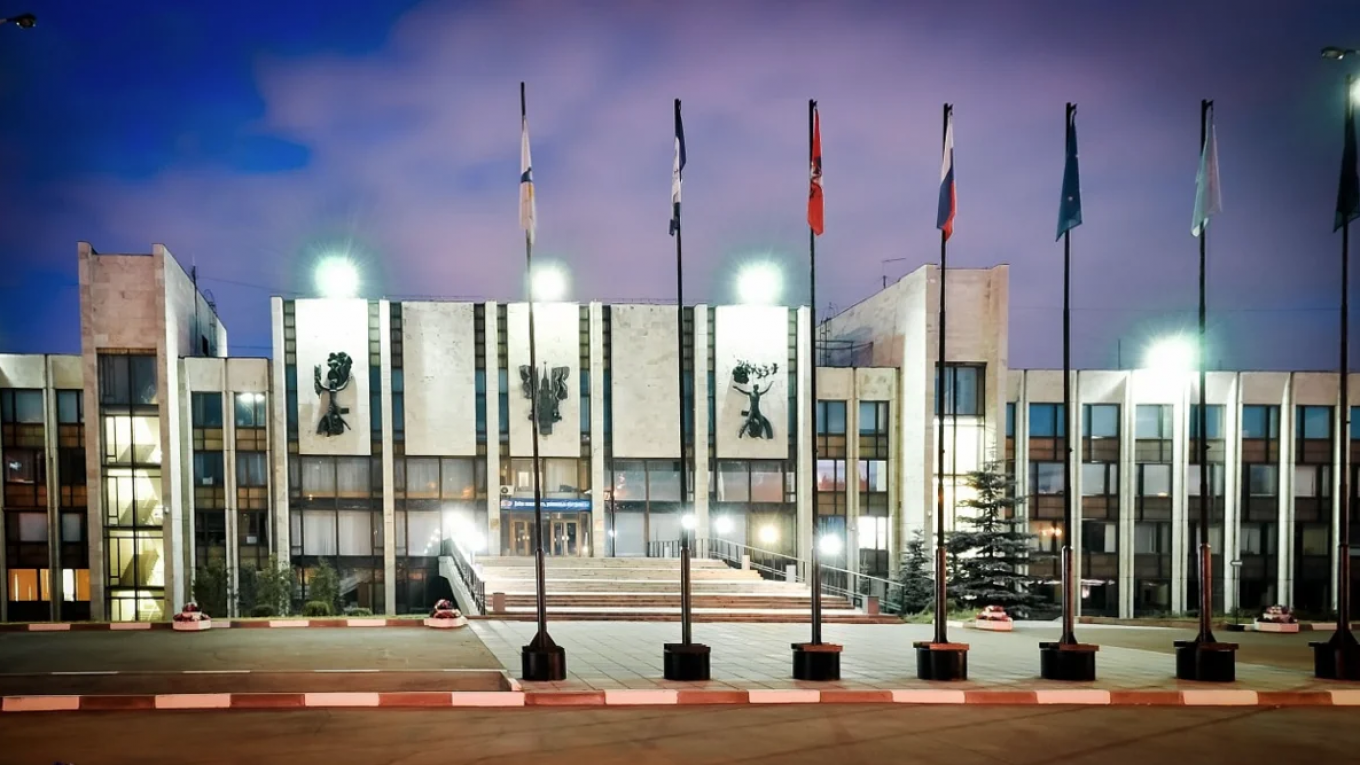
Russian intelligence services are actively recruiting students from the prestigious Moscow State Institute of International Relations (MGIMO), the independent Proekt online outlet reported in an investigation Thursday.
MGIMO is considered one of Russia’s elite academic institutions, training future government leaders and diplomats, as well as businesspeople, journalists and thinkers. Its alleged ties to Russia's secret services came into focus last year when Poland’s foreign ministry said it had fired hundreds of MGIMO graduates as part of a large-scale overhaul.
“It’s no secret that they recruit into the security agencies at MGIMO,” Proekt quoted an unnamed graduate, who reportedly attended a recruitment drive in 2010, as saying.
Another student recounted a 2015 meeting with a recruiter who drew attention to his “unique” knowledge of the Montenegrin language and urged him to think about “the future, the motherland and a career.”
Intelligence services around the world regularly recruit graduates from top diplomatic schools, prizing them for their language and analytical skills.
The Proekt investigation came ahead of President Vladimir Putin’s visit to the Gerasimov State University of Cinematography (VGIK) Thursday, where he called Russian students’ work abroad a “major soft power.” 
Putin also lauded MGIMO alumni’s “patriotism and fidelity to duty while protecting our country’s foreign policy interests” on the 75th anniversary of its founding earlier this week.

Russians accused of extremism cut wrists in court

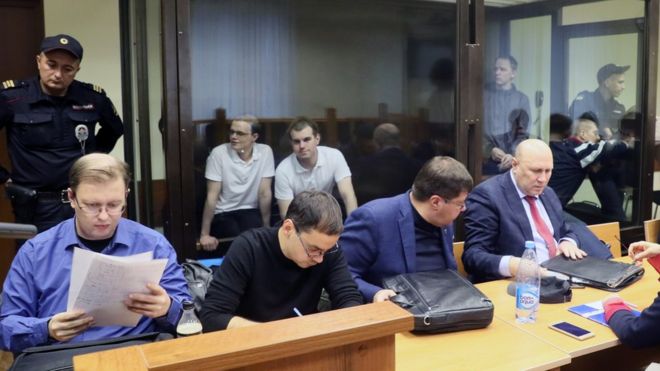
Vyacheslav Kryukov (far left) and Ruslan Kostylenkov (2nd left) in court
Two Russians on trial for belonging to an anarchist organisation have slit their wrists in a Moscow courtroom.
The pair, Ruslan Kostylenkov, 25, and Vyacheslav Kryukov, 20, face extremism charges after being accused of belonging to Novoye Velichiye (New Greatness) group.
They were removed from the witness stand. Their condition is not yet known, Russian media report.
Both had called to be put under house arrest but had their request rejected.
When their request was denied, they reportedly told the courthouse: "This is an unfair trial" and "Glory to Russia, freedom of Russia, freedom of political prisoners."
They then slit their wrists.
Lawyer Alexander Lupashko said it was unclear how the pair had managed to get sharp objects into the courtroom.
"They were checked by dogs. I believe either a piece of glass or a piece of a blade was carried in there," he said.
The pair are part of a group of 10 young people facing trial on charges of creating an extremist organisation and seeking to overthrow President Vladimir Putin's government. The suspects include teenagers.
One alleged member of the group, Anna Pavlikova, 19, has already been charged. Her health deteriorated in prison and she was later placed under house arrest.
The prosecution's case largely relies on the testimony of an undercover policeman who infiltrated the group.
Human rights groups say the suspects were set up. Parents of the suspects say the group discussed everyday life such as school, work and in some cases, politics.


Thursday, October 17, 2019

Russia detains American diplomats for traveling to top-secret military site

Severodvinsk

Russian authorities detained three American diplomats because they allegedly tried to enter a highly secret weapons testing site in northern Russia, according to reports. The site in question is located near the northern Russian city of Severodvinsk. The city is home to a number of military shipyards and is thus restricted for non-Russians. The latter require a special permit to enter it.
In August of this year, Western media reported on a mysterious explosion that took place in a weapons research site located near Severodvinsk. The explosion allegedly happened during testing of a top-secret prototype rocket engine. Russian authorities revealed that five workers died as a result of the explosion, but denied media reports that the explosion had caused a radiation leak that had affected Severodvinsk. The Russian Ministry of Defense also denied allegations that a large-scale nuclear clean-up operation had been conducted in and around Severodvinsk. At the same time, Russian authorities restricted maritime traffic in the White Sea, on the shores of which Severodvinsk is situated.
On Wednesday, the Russian news agency Interfax reported that three American diplomats had been detained by authorities near Severodvinsk, allegedly because they tried to enter the city without the necessary permits. The diplomats were not named but are believed to be military attachés that serve in the United States embassy in Moscow. Interfax said the three were detained on Monday while onboard a passenger train. They were removed from the train, questioned and eventually released. However, they might still face charges of trying to enter a restricted area without permission.
The United States Department of State issued a statement claiming that the three diplomats “were on official travel and had properly notified Russian authorities of their travel”. A State Department spokesman said on Wednesday that the three diplomats’ travel plans had been authorized by the Russian Ministry of Defense. But authorities in Russia said that the three military attachés had been authorized to travel to the city of Arkhangelsk, which is located approximately 30 miles east of Severodvinsk. “We are quite willing to provide the United States embassy with a map of the Russian Federation”, the Russian statement concluded.
► Author: Joseph Fitsanakis

US Special Forces secrets could fall into hands of Russians as Kurds side with Syria

Yekîneyên Antî Teror‎


American defense officials with knowledge of Special Operations Forces activities in Syria are concerned that their secrets may fall into the hands of the Russians, as the Kurds switch their allegiance to the Moscow-backed Syrian government. Members of the United States Special Operations Forces and the Central Intelligence Agency (CIA) have had a presence in Kurdish-dominated northern Syria since at least 2012. Following the rise of the Islamic State in 2014, the Americans have worked closely with the Kurds in battling the Islamist group throughout the region.
Throughout that time, US Special Operations Forces have trained members of the Syrian Democratic Forces (SDF), a political and military umbrella of anti-government Syrian groups, which is led by the Kurdish-dominated People’s Protection Unit (YPG) militias. Until recently, the SDF and the YPG were almost exclusively funded, trained and armed by the US through its Special Operations Forces units on the ground in northern Syria. US Special Operations Forces were also behind the creation in 2014 of the SDF’s most feared force, the Anti-Terror Units. Known in Kurdish as Yekîneyên Antî Teror‎, these units have been trained by the US in paramilitary operations and are tasked with targeting Islamic State sleeper cells.
As of this week, however, the SDF and all of its US-trained militias have switched their allegiance to the Russia-backed government of Syrian President Bashar al-Assad. The dramatic move followed the decision of the White House earlier this month to pull its Special Operations Forces troops from norther Syria, effectively allowing the Turkish military to invade the region. According to the American defense news website Military Times, US Pentagon officials are now worried that the SDF may surrender to the Russians a long list of secrets relating to US Special Operations Forces’ “tactics, techniques, procedures, equipment, intelligence gathering and even potentially names of operators”.
One former US defense official told The Military Times that SDF “may be in survival mode and will need to cut deals with bad actors” by surrendering US secrets. Another source described this scenario as “super problematic” and a symptom of the absence of a genuine American strategy in the wider Middle East region. The website also cited US Marines Major Fred Galvin (ret.), who said that Special Operations Forces tend to reveal little about themselves and their capabilities when working with non-US actors. However, this is uncharted territory for them, said Galvin, since “we’ve never had a force completely defect to an opposition like this before”.
► Author: Joseph Fitsanakis 

Mossad chief comments on policy of assassinations in rare interview

Yossi Cohen

Yossi Cohen, the chief of the Mossad —Israel’s main external intelligence agency— said he has authorized “more than a few” assassinations during his tenure and warned that more may be on the way. Cohen, 57, who took command of the Mossad in 2016, spoke last week to Mishpacha, a magazine aimed at ultra-orthodox Jews. His comments were covered widely by Israeli media over the weekend.
Cohen was asked to respond to recent allegations made by the Iranian government that Israel worked with “Arab countries” to assassinate General Qassem Suleimani, the head of the Quds Force, an elite paramilitary unit in Iran’s Islamic Revolutionary Guard Corps (IRGC). Suleimani claimed that several individuals were arrested last month in connection with the alleged plot. He also said that Israel tried to kill him and Hassan Nasrallah, leader of the Lebanese Hezbollah group, in 2006.
The head of the Mossad told Mishpacha that Suleimani had not “necessarily committed the mistake yet that would place him on the prestigious list of Mossad’s assassination targets”. However, “he knows very well that his assassination is not impossible” because “the infrastructure he built presents a serious challenge for Israel”, said Cohen. Regarding Nasrallah, Cohen said that the Hezbollah strongman “knows we have the option of eliminating him”. When asked why the Mossad had not exercised that option, Cohen said he preferred not to answer.
In regards to Hamas, the Palestinian militant group that controls the Gaza Strip, Cohen admitted that the Mossad has been behind a string of assassinations of Hamas officials around the world in recent years. “If there is one target that we eliminate without hesitation, it is Hamas officials abroad. [These range] from local agents to those who manage acquisitions of weapons pointed towards Israel”, said Cohen. He added that there had been “more than a few assassinations” in recent years, but not all were admitted to by Hamas. “The enemy has changed tactics. It is not quick to attribute assassination to us, for its own reasons”, said the Mossad chief.
► Author: Joseph Fitsanakis 

Friday, October 11, 2019

US and Saudi Arabia ‘suffered intelligence blackout’ during Iran drone strikes: sources

Saudi Aramco


Saudi Arabia and the United States suffered “a total and embarrassing [intelligence] failure” in the lead-up to the drone strikes that shut down half of the kingdom’s oil production last month, according to Israeli sources. In the early hours of September 14, missiles struck two refineries belonging to the world’s largest crude oil processing facility in eastern Saudi Arabia. The facilities, which belong to Aramco, Saudi Arabia’s government-owned oil conglomerate, were forced to cease operation so that repairs could be carried out. This drastically reduced Saudi Arabia’s oil production by close to 50 percent, which amounted to a 5 percent drop in global oil production. By Monday morning, global oil prices had seen their most significant one-day surge since the 1991 Gulf War.
Soon after the attacks, Saudi and American officials accused Iran of having launched the missile strikes. But according to Breaking Defense, Riyadh and Washington suffered “a total and embarrassing [intelligence] failure” in the hours prior to and following the attacks. The US-based website cited a number of anonymous Israeli sources, who said that officials in Tel Aviv were surprised by the lack of intelligence in the US and Saudi Arabia about the missile strikes. The Israelis told Breaking Defense that Saudi intelligence agencies “had no idea Iran was planning to attack the kingdom’s oil facilities […]. It seems that the Americans were also in the dark [or that possibly] Washington […] did not share the data in time with the Saudis”, they added.
The above information was allegedly discussed at an emergency meeting of the Israeli defense cabinet on October 6, which included a briefing on the attacks by the Mossad, Israel’s main external intelligence agency. According to the Israeli sources, Mossad officials were quickly able state with high confidence that the missiles had been launched from military bases in southeast Iran or by Iranian militias in Iraq. It was only following an examination of missile fragments that Saudi and American intelligence officers were able to point the finger at Iran, according to Aahron Ze’evi Farkash, former director of the Israeli Military Intelligence Directorate.
Breaking Defense also said that Israeli intelligence analysts were impressed by the precision of the weapons systems used in the Iranian strikes. Additionally, the specific targets of the attacks were selected with the help of “very accurate intelligence”, said the Israeli sources.
► Author: Joseph Fitsanakis