Friday, October 11, 2019

Concerns about mass breakouts of jailed ISIS fighters if Turkey invades northern Syria

Turkey ISIS

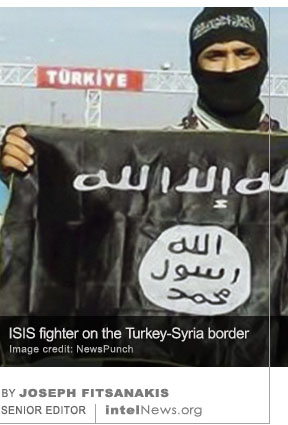
Officials in the United States, Europe and the Middle East have warned that thousands of jailed members of the Islamic State could escape from Kurdish-controlled prisons in northern Syria if Turkey invades the region. For more than two years, the area has been controlled by American-supported Kurdish militias, who were instrumental in helping Washington defeat the Islamic State —also known as Islamic State of Iraq and Syria, or ISIS. But the growing strength of the Kurdish forces has alarmed Turkey, which views Kurdish nationalism in the region as a bigger threat than Salafi jihadism. Ankara has repeatedly threatened to invade northern Syria and disarm the Kurdish groups, which it sees as terrorist.
The continuous presence of American troops in northern Syria has served to dissuade Turkey from invading. Yesterday, however, the White House surprised observers by announcing its sudden decision to pull its troops from northern Syria. Washington’s unexpected move drew criticism from Kurdish commanders who spoke of betrayal, as well as by members of both political parties in Congress. Security officials also expressed fears that Turkey’s focus on the Kurds could allow ISIS to regroup in northern Syria. A statement issued by the White House on Monday said that Turkey would assume control of over 10,000 captured ISIS fighters who are currently being held in Kurdish-administered prison camps in northern Syria. But experts said that the wider Kurdish-controlled region of northern Syria, which Turkey intends to capture, is home to dozens of prisons with over 60,000 captured ISIS supporters in them. What will be the fate of these prisoners under Turkish control?
Security observers have repeatedly accused Turkey in the past of turning a blind eye to ISIS, whose members fought a prolonged and bloody war against Iraqi and Syrian Kurds from 2016 to 2018. There are no guarantees that the Turks will not utilize a resurgent ISIS to suppress Kurdish nationalism in the region. In fact, some experts, including retired American generals, warned on Monday that a Turkish invasion of northern Syria would give ISIS “a golden chance to regroup”. There are concerns of mass breakouts of ISIS members from Kurdish-controlled prisons in Syria, amidst the widespread chaos caused by a Turkish military onslaught. Such breakouts have been encouraged by ISIS leaders, including Abu Bakr al-Baghdadi himself. Escaped prisoners would most likely join the nearly 20,000 estimated ISIS fighters who are still at large in Iraq and Syria, thus contributing to a potentially catastrophic regeneration of the militant Sunni group, according to experts.
► Author: Joseph Fitsanakis 

NEVER SAY NEVER Aliens DO exist and we are not alone in the universe, says Britain’s former top spook

 Sir John explained that due to the infinite size of the universe there most be other life forms out there
Sir John explained that due to the infinite size of the universe there most be other life forms out there.


THE former-head of MI6 has stated that he believes aliens exist - a view that's supported by more than half of Britain.
Sir John Sawers, 64, is certain extraterrestrials are out there due to the infinite size of the universe.
The Warwick-born ex-spy said it would be "extraordinary" if life only existed on earth and is adamant that we can't be alone.
He was the Chief of the Secret Intelligence Service from 2009 until 2014.
Sir John told the Daily Star: "I think it would be extraordinary if in an infinite solar system that planet Earth was unique.
“I think we should go forward on the assumption that nothing on this planet is unique."

BRITS BELIEVE IN ALIENS

Around 52 per cent of Brits believed intelligent life exists elsewhere in the solar system, according to a YouGov survey in 2015.
We fell below 56 per cent of Germans and 54 per cent Americans.
Brits over the age of 60 were found to be more skeptical of extraterrestrials existence with 45 per cent not sharing the belief.
Whereas a whopping 59 per cent of 18-24-year-olds did.

GOVERNMENT COVER UP

A smaller number of us also think that humans are not technologically advanced enough to communicate with aliens.
Meanwhile a fifth of Brits believe the government have covered up dealings with beings from outer space.
Sawers claims came just over a month after astronomers discovered a planet where life could have existed.

EARTH-LIKE PLANET FOUND

Water was spotted in the atmosphere of K2-18b, a planet two times the size of earth, scientific journal Nature Astronomy wrote.
It's located within a safe distance of a star and around 111 light years away, or 650 million million miles away, from earth.
K2-18b is too far away to send a probe but in 10 years it's hoped that telescopes will be able to see more of it.
Then they will look for gases that could support an atmosphere for living organisms.
Professor Stephen Hawking was among believers and before his death in March 2018 backed a new project to track them down.
The Breakthrough Initiative aims to discover if we are alone, if there are other habitable worlds out there and if so, how can we get there.
Earth circles one star among of hundreds of billions in a galaxy that is among hundreds of billions others, in a possibly infinite universe, they wrote.
Prof. Hawking called the search for extraterrestrial life "the most exciting quest in 21st century science".


Thursday, October 3, 2019

FBI files espionage charges against California man who allegedly spied for China

The United States has pressed espionage charges against a naturalized American citizen who operated as a courier for Chinese intelligence while working as a tour operator in California. On Monday federal prosecutors in San Francisco filed espionage charges against Xuehua “Edward” Peng, a 56-year-old Chinese-born American citizen. Peng, a trained mechanical engineer, reportedly entered the United States in June 2001 on a temporary visa. In 2012 he became a naturalized American citizen. By that time he was working for US Tour and Travel, an independent tour operator in California.
On Friday, officers with the Federal Bureau of Investigation arrested Peng at his home in Hayward, California, and charged him with spying on behalf of the Ministry of State Security (MSS), which is China’s primary external intelligence agency. At a press conference held on Monday, David Anderson, US Attorney for the Northern District of California, said that Peng began working for the MSS in June 2015 and continued to do so until June of 2018. Throughout that time, Peng participated in at least six dead drops on behalf of the MSS, said the FBI. But he was unaware that the agent on the other end of the dead drop was in fact an FBI informant, who had lured Peng and the MSS into an elaborate sting operation. The informant is referred to in the indictment as “the source”. The FBI said it paid the informant nearly $200,000 to facilitate the sting operation.
Most of the dead drops took place at a hotel in Newark, California. Peng would book a room in the hotel using a popular online booking service. He would check in and go to his hotel room, where he would hide envelopes containing as much as $20,000 in cash. He would then leave the room key at the front desk for his contact to pick up. The contact (the FBI informant) would pick up the key and the cash, and leave memory sticks with classified US government information for Peng to pick up. Peng would then travel to China to deliver the classified information to the MSS.
Unbeknownst to Peng, the FBI was monitoring him all along, and managed to secretly tape his alleged espionage activities. The surveillance footage is now part of the federal affidavit that was unsealed on Monday. Moreover, the FBI appears to have given Peng classified information that was approved for the purposes of the counterespionage operation against him. It is not known whether the classified information was real, deceptive, or a mixture of the two. It is worth noting that Peng is not a foreign diplomat and is therefore not subject to the rules of diplomatic immunity. He now faces a maximum of 10 years in prison and a fine of up to $250,000 if convicted.
► Author: Joseph Fitsanakis

Colombian spy chief resigns over fake dossier that linked militants to Venezuela

Comando Conjunto de Inteligencia

Colombia’s military spy chief has resigned, after the Colombian president was found to have misused intelligence at a United Nations speech to blame Venezuela for allegedly aiding paramilitary groups. For many years, authorities in Bogotá have accused Venezuela of aiding armed groups such as the National Liberation Army (ELN) and the Revolutionary Armed Forces of Colombia (FARC). These groups have been engaged in a decades-long guerrilla war against the Colombian state. In 2017, the largest of these groups, the FARC, laid down its weapons and signed a peace treaty with the Colombian government. But the ELN has refused to follow suit, while a number of hardline FARC leaders recently announced that they would be resuming their armed struggle against the Colombian authorities.
In recent months, the rise of Venezuela’s Western-supported opposition leader Juan Guaidó has further-fueled tensions between Colombia and Venezuela. Bogotá has come out in support of Guaidó, while many anti-government Venezuelans, some of them armed, have sought refuge in Colombia. Colombia rejects Venezuela’s claims that it is giving shelter to terrorists and argues instead that it is providing humanitarian aid to Venezuelan refugees. In turn, it accuses Caracas of sheltering ELN and FARC guerrillas, a claim that the Venezuelan government strongly denies.
Last week, during the United Nations General Assembly in New York, Colombian President Iván Duque unveiled a dossier of evidence that purportedly proved beyond doubt Venezuela’s collusion with Colombian paramilitaries. Duque told the United Nations gathering that the collusion was supervised by no other than the President of Venezuela, Nicolás Maduro. But within hours of Duque’s speech, reporters who scrutinized the dossier found that much of the photographic evidence in it had been downloaded from the Internet. Moreover, the photographs were not taken in Venezuela, as Duque claimed in his speech, but in Colombia.
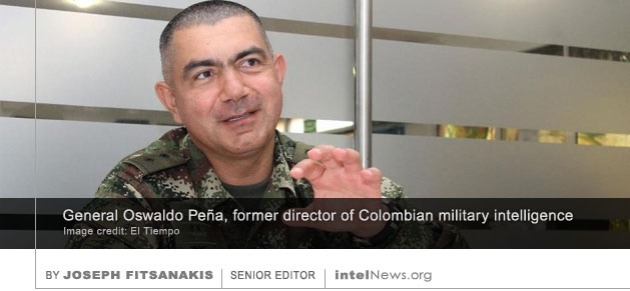
The revelations have dominated the news headlines in Colombia and Venezuela in the past week, with the Colombian government engaging in damage control. On Monday, General Oswaldo Peña, Colombia’s military intelligence chief, resigned over the fake dossier. General Peña directed the Comando Conjunto de Inteligencia (Joint Intelligene Command) of the Colombian Armed Forces, which was seen as the primary spy agency behind the information contained in the dossier. In his resignation letter, General Peña wrote that “as a general of the [Colombian] Republic” he was fully aware that he needed to take responsibility for his activities and the activities of his subordinates. President Duque has not commented on the general’s resignation.
► Author: Joseph Fitsanakis

Wednesday, July 31, 2019

Austria issues international arrest warrant for alleged Russian spy

Igor Egorovich Zaytsev

The Austrian government has issued an international arrest warrant for a Russian man who allegedly recruited a retired colonel in the Austrian Federal Army to spy for Moscow. The arrest warrant was issued on Tuesday by the public prosecutor’s office in the city of Salzburg. It identifies the Russian man as Igor Egorovich Zaytsev. Austrian officials allege that the Moscow-born Zaytsev is in fact an intelligence officer for the Main Directorate of the General Staff of the Russian Armed Forces. Known as GRU, the organization is Russia’s primary military-intelligence agency.
In an accompanying press statement issued on Tuesday, the Austrian Ministry of the Interior said that Zaytsev had facilitated the “betrayal of state secrets” and that his actions had been “to the detriment of the Republic of Austria”. The arrest warrant accuses Zaytsev of having participated in the “intentional disclosure of a military secret”, but does not provide details. However, in a subsequent statement, Austrian police directly linked the search for Zaytsev with an espionage case that was reported in the Austrian media last year. The statement said that Zaytsev is believed to have recruited a man known as “Martin M.” to spy on Austria. This appears to refer to the arrest last November of a 70-year-old colonel in the Austrian Army, who was stationed in Salzburg. He is believed to have spied for Russia from at least 1992 until his arrest. Austrian media reported that the accused spy was believed to have given Russia information on a range of weapons systems used by the Austrian Army and Air Force, as well as the personal details of high-ranking officers in the Austrian Armed Forces.
Soon after the arrest of “Martin M.”, Austrian authorities arrested a second man, identified only as “O.”, who is also suspected on having spied for Russia. According to the Vienna Public Prosecutor’s Office, “O.” was an employee of the Austrian Office for Protection of the Constitution and Counterterrorism, known as BVT. He had been investigated on suspicion of espionage for more than a year prior to his arrest. The man’s arrest took place alongside simultaneous raids at two residential addresses associated with him, according to reports. No further details have been made available since the arrest. It is not known whether Zaytsev’s is also connected with the case of “O.”.
► Author: Joseph Fitsanakis 

Spain’s second largest bank under investigation in massive espionage scandal

José Manuel Villarejo

Spain’s second largest bank has been placed under investigation in connection with a probe into an illegal network that spied on scores of politicians, business executives, journalists and judges for over 20 years. The investigation centers on José Manuel Villarejo (pictured), a 67-year-old former police chief, who remains in pre-trial custody following his arrest in November of 2017 for carrying out illegal wiretaps. State prosecutors accuse Villarejo of running an illicit information-collection enterprise that violated the privacy of hundreds of unsuspecting citizens. Villarejo’s victims were targeted by corporate competitors and individual wealthy clients. Many were eventually blackmailed by the recipients of the information that was collected by the former police chief and his network.
On Tuesday, Spain’s High Court, the Audiencia Nacional, placed the country’s second-largest bank, the BBVA, under formal investigation in connection with the Villarejo case. Audiencia Nacional Judge Manuel García-Castellón took the decision to investigate the BBVA after government prosecutors argued that the bank was one of Villarejo’s main clients, as shown in documents seized from the former police chief in 2017. According to the prosecution, the bank made illicit payments to a company called Cenyt, which was owned by Villarejo. The payments lasted for over 13 years, during which Villarejo earned close to €10 million ($11.1 million) from BBVA. In return, Villarejo and his employees carried out surveillance operations on behalf of the bank. One of the operations targeted Sacyr, a large Spanish-based construction company, which had tried to purchase BBVA in 2004 and 2005. Spanish government prosecutors now accuse BBVA of bribery, disclosure of sensitive information, and corrupt business practices.
In January of 2018 five active police officers and an employee of the Agencia Tributaria, Spain’s tax revenue service, testified in court about having worked for Villarejo’s network. They disclosed information about Operation KITCHEN, an espionage effort that targeted Luis Bárcenas, a senator and party treasurer of Spain’s conservative Partido Popular. The purpose of Operation KITCHEN was to wiretap Bárcenas’ communications without acquiring a court warrant, said the witnesses. Last year Bárcenas was jailed for 33 years for his role in the so-called Gürtel case, the largest corruption scandal in modern Spanish history, which brought down the conservative government of Prime Minister Mariano Rajoy in July of 2017. Villarejo’s trial continues.
► Author: Ian Allen 

Dramatic moment British fighter jets intercept Russian military transport plane as it passes close to Estonian air space

Royal Air Force Typhoon fighter jets intercept a Russian IL-76 military transport aircraft that was flying close to Estonian airspace.


This is the the dramatic moment RAF jets intercept a Russian military aircraft which passed close to Estonian airspace.  
Typhoon fighter jets operating from Ämari Air Base in Estonia launched on Sunday to escort the Russian IL-76 military transport aircraft away from Estonian territory.
Dramatic pictures show the jets flying close to the larger Russian plane as they intercepted it as part of a NATO deterrent mission. 
Defence Secretary, Ben Wallace, said: 'As this latest Quick Reaction Alert demonstrates, the RAF are frequently called upon to use their world class skills and capabilities to help police and protect the skies over the Baltics.
'Our personnel deployed to Estonia and around the world are always ready to react to any scenario as we continue our commitment to our NATO allies.'
A Typhoon pilot from XI(Fighter) Squadron, attached to 121 Expeditionary Air Wing (EAW), was conducting Quick Reaction Alert (QRA) duty when the scramble was called. 
He said: 'We were scrambled to intercept an aircraft that was approaching Estonian airspace from the south. We identified and monitored it as it transited close to NATO airspace. 
a plane flying in the air: Dramatic pictures released by the Ministry of Defence show the RAF Typhoon flying close to the Russian plane
'This is standard protocol for aircraft that might not be communicating with Air Traffic Control or on a recognised flight plan.
'We continued to escort the transport aircraft as it transited in a north direction, away from Estonian airspace.'
The Royal Air Force is deployed on Operation AZOTIZE in Estonia in support of Baltic Air Policing.
This is the 14th QRA scramble and intercept since the RAF took over enhanced Air Policing from the German Air Force on 3 May 2019 as part of Baltic Air Policing.  
a fighter jet flying through a blue sky: The Royal Air Force is deployed on Operation AZOTIZE in Estonia in support of Baltic Air Policing