Monday, December 11, 2017

Israel, Turkey leaders trade insults over US Jerusalem decision

Istanbul (AFP) - Relations between Israel and Turkey took a bitter turn Sunday as their leaders traded accusations of involvement in terrorism, days after the US recognition of Jerusalem as Israel's capital.
Turkish President Recep Tayyip Erdogan said he would fight against the controversial declaration, describing Israel as a "terrorist state" that kills children, in a speech in Istanbul.

Hours later Israel's Prime Minister Benjamin Netanyahu hit back, calling his counterpart a leader who bombs Kurdish villagers and supports terrorists, during an official visit to Paris.

The two countries had normalised relations in recent years, but Sunday's flare-up came after Turkey was angered by US President Donald Trump's decision to recognise Jerusalem as the capital of Israel.
Trump's move has sparked protests in Muslim and Arab countries for four days.

"Palestine is an innocent victim... As for Israel, it is a terrorist state, yes, terrorist!" Erdogan said in a speech in the central Turkish city of Sivas.

"We will not abandon Jerusalem to the mercy of a state that kills children."

Erdogan earlier described the status of Jerusalem, whose eastern sector Palestinians see as the capital of their future state, as a "red line" for Muslims.

Netanyahu was quick to counter the assault when he spoke later during a press conference alongside French President Emmanuel Macron.

"I am not used to receiving lectures about morality from a leader who bombs Kurdish villagers in his native Turkey, who jails journalists, who helps Iran go around international sanctions, and who helps terrorists, including in Gaza, kill innocent people," he said.

"That is not the man who is going to lecture us."

The Israeli premier's comments were immediately denounced by Erdogan's spokesman Ibrahim Kalin who said: "Instead of taking on our country and our leader, the Israeli authorities would do better to end their occupation of the Palestinian territories."

Erdogan has used his position as the current chairman of the Organisation of Islamic Cooperation (OIC) to call a summit of the pan-Islamic group on Wednesday.

"We will show that applying the measure will not be as easy as that," he added on Sunday, referring to the US recognition of Jerusalem.

He said it was "absurd" to deny the Jews' "ancient connection" to Jerusalem.

During his speech, Erdogan held a picture of what he said was a 14-year-old Palestinian boy from Hebron, in the Occupied West Bank, being dragged away by Israeli soldiers.

Turkey and Israel had improved diplomatic ties in recent years but Erdogan has continued to defend the Palestinian cause and has regularly criticised Israeli policy.

Putin makes first visit to Syria, lauds victory over ISIS

Russian President Vladimir Putin on Monday made a surprise visit to Russia’s Khmeimim air base in Syria, announcing an imminent drawdown of Russian forces in the wake of his declaration of victory in its intervention in the Syria war.

In his first visit to the air base since Russian warplanes secretly flew to Syria in late 2015, Putin ordered his defense minister, Sergei Shoigu, to begin the “withdrawal of Russian troop contingents” to their permanent bases. 

But Putin left open the door to a continued Russian presence in Syria, saying that both Russia’s air base at Khmeimim and naval base at Tartus would keep operating. He promised further strikes in the future “if terrorists raise their head again” — an apparent reference to forces in Syria’s long civil war that sought to topple the regime of Syrian President Bashar al-Assad.

“We will deliver such strikes on them that they have not seen yet,” he said in remarks to military personnel at the air base.

Russia’s military intervention in Syria bolstered Assad’s government and gave Syrian forces a critical edge against rebel factions backed by the West and its Middle East allies. Iran, another key supporter of Assad, provided military advisers and other aid.

The speech to the troops also had the whiff of a reelection campaign to it at times.

“You are victorious and you are going home to your families, parents, wives, children, and friends,” Putin told pilots at the air base, in remarks carried by Russian news services. “The fatherland is waiting for you, my friends. Have a safe trip home. I am grateful for your service.”

The deployment of troops to Syria marked Moscow’s first major overseas military campaign since the invasion of Afghanistan under the Soviet Union. In July, Russia extended its lease of the Khmeimim air base for 49 years, giving Moscow a military foothold in the region for several generations. 

At the air base, Putin met with Syrian leader Assad, whose regime appeared close to defeat in the summer of 2015 before the Russian intervention. At the time, it appeared Assad would be forced to step down.

“I have come, as I promised,” Putin told him, according to remarks carried by the Interfax news agency. While hailing the fall of the extremist Islamic State group, Putin also noted the rebuke to Western plans in the region. “Syria has been preserved as a sovereign independent state,” he said.

Putin has been eager to declare the intervention a victory, and has already announced several times that he would order Russian troops to withdrawal. The first drawdown was announced by Putin in March 2016, as Syrian troops backed by Russian air power and special forces, made a final push to recapture the ancient Roman city of Palmyra.

Western leaders were skeptical that Russia would pull back its troops, and Russian forces were later key in the race to snatch up territory ahead of Islamic State’s eventual collapse. 

The intervention has showcased much of Russia’s military might: state-of-the-art warplanes, helicopters, and warships, cruise missiles fired from the Caspian Sea, as well as a contingent of ground troops estimated by Russian military experts and press at several thousand. Several dozen Russian troops have been killed in more than two years of combat, according to Russian military statistics, and dozens of others, likely serving as military contractors, have also died.  

Botched ISIS Pipe Bomb in New York City

There are reports of a terror attack in New York City, after an explosion was felt Monday morning in a Subway station near Times Square.

Commuters said they felt a blast in the Subway tunnels underneath the Port Authority Bus Terminal around 7:30am. The bus terminal is a major transit hub for people commuting to and from New Jersey by bus, and is located just a block from Times Square. 

Police have taken one man into custody, who was carrying a pipe bomb with a battery back, a source told the New York Post.  He was injured when the bomb malfunctioned, but is alive and in stable condition, according to the FDNY. 

While the suspect has not been identified by name, former NYPD Commissioner Bill Bratton told MSNBC's Morning Joe that he's a man in his 20s, possibly from Bangladesh. 

He added that the suspect 'supposedly was setting the device off in the name of ISIS' and that it was 'definitely a terrorist attack, definitely intended'.

CNN reports that it appears the Subway was not the intended target of the pipe bomb, and that it may have went off prematurely. 

They also learned that the device was homemade and could have caused catastrophic damage if it went off as intended.  

So far, the only reports of injuries are to the suspect himself. 

Law enforcement agencies have responded to the scene and have set up a perimeter around the area. 
The entire Port Authority Bus Terminal has been shut down, as well as the subway station underneath it.

The blast happened less than a week after President Trump sparked violence in the Middle East by officially recognizing Jerusalem as Israel's capital city. 

Palestinians leaders vowed 'three days of rage' to protest the controversial decision. 
White House Press Secretary Sarah Huckabee Sanders tweeted Monday morning that the president had been briefed on the situation.  


http://www.dailymail.co.uk/news/article-5167317/Explosion-reported-NYC-Port-Authority-bus-terminal.html#ixzz50xdRfATT


Trial set for ex-cop accused of supporting Islamic State


The first law enforcement officer in the U.S. ever to be charged with a terrorism offense is again scheduled for trial.

Jury selection begins Monday afternoon in federal court in Alexandria, Virginia, in the case against Nicholas Young, who was a police officer in the region’s Metro system when he was arrested last year in a government sting.

Prosecutors say Young bought nearly $250 in gift cards he intended for the Islamic State group, giving the cards to an individual who turned out to be an FBI source.

Young’s lawyers say the sting amounts to entrapment after their client was under surveillance for six years.

Documents show Young had been under surveillance since 2010.

The trial had been expected to begin last week but was delayed when new evidence emerged.

https://www.seattletimes.com/nation-world/trial-set-for-ex-cop-accused-of-supporting-islamic-state/

Friday, December 8, 2017

Arab world responds to Trump’s Jerusalem decision with protests and warnings


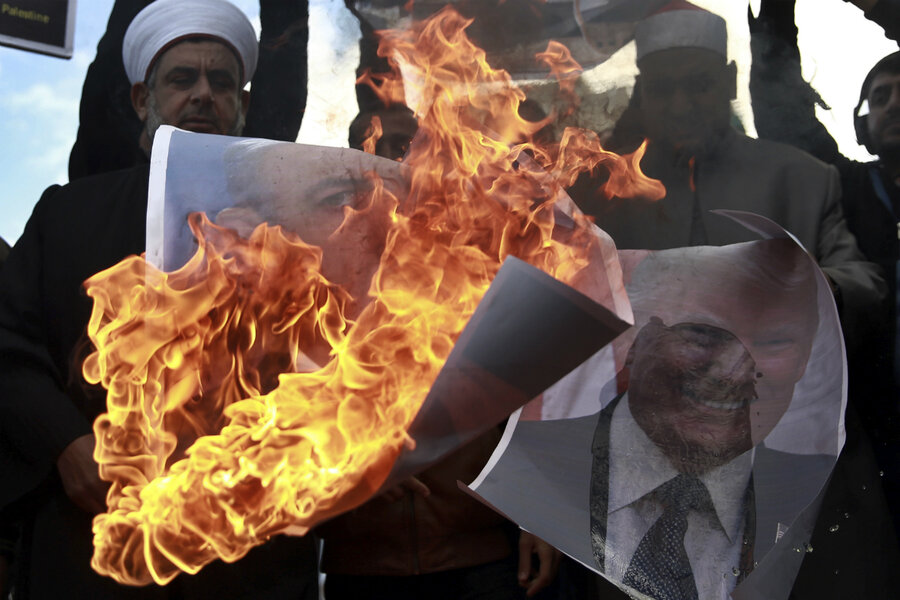
Clashes between hundreds of Palestinian protesters and Israeli troops erupted across the West Bank on Thursday while demonstrators in Gaza burned posters of President Trump and Israeli Prime Minister Benjamin Netanyahu, as well as Israeli and United States flags.
The leader of the Hamas militant group, which runs Gaza, called for a new armed uprising in a widespread show of anger over Mr. Trump's move to recognize Jerusalem as Israel's capital.
In the West Bank, crowds of protesters set tires on fire and hurled stones at anti-riot troops. In the biblical town of Bethlehem, troops fired water cannons and tear gas to disperse a crowd, in clashes that cloud the upcoming Christmas celebrations in the town of Jesus' birth. In Ramallah, the seat of the Palestinian government, protesters set tires on fire, sending a thick plume of black smoke over the city.
Trump's dramatic break on Wednesday with decades of US policy on Jerusalem counters long-standing international assurances to the Palestinians that the fate of the city will be determined in negotiations. The Palestinians seek Israeli-annexed east Jerusalem, captured by Israel in 1967, as a future capital.
Palestinians shuttered their schools and shops on Thursday to begin three "days of rage" over Trump's decision. Rallies were underway in other West Bank cities, and a demonstration was being held outside the Damascus Gate of Jerusalem's Old City.
There were no serious casualties reported in Thursday's clashes. But Friday, the Muslim holy day, could provide an important test when Palestinians gather for weekly mass prayers.
In the Gaza Strip, Hamas' leader Ismail Haniyeh called on Palestinians to launch a new intifada, or uprising, against Israel on Friday.
"The American decision is an aggression on our people and a war on our sanctuaries," Mr. Haniyeh said in a speech, urging supporters "to be ready for any orders."
"We want the uprising to last and continue to let Trump and the occupation regret this decision," he said.
Hamas, a group that seeks Israel's destruction, killed hundreds of Israelis in suicide bombings and other attacks in the early 2000s. But the group's capabilities are more limited now. Gaza, Hamas' stronghold, is closed by an Israeli blockade, while in the West Bank, many of its members have been arrested. Nonetheless, it possesses a large arsenal of rockets capable of striking much of Israel.
Spontaneous protests sparked in Gaza overnight, with angry youths burning tires, American and Israeli flags, and Trump posters.
The Israeli military said it would deploy several battalions to the West Bank ahead of Friday, while other troops have been put on alert to address "possible developments."
The conflicting claims to Jerusalem, and especially its Old City, where sensitive Jewish, Muslim, and Christian holy sites are located, lie at the core of the Israeli-Palestinian conflict. While Trump's decision had no impact on the city's daily life, it carried deep symbolic meaning, and was seen as siding with Israel and an attempt to impose a solution on the Palestinians.
Israel, which claims all of Jerusalem as its undivided capital, has welcomed Trump's decision.
Prime Minister Netanyahu said Trump "bound himself forever" to the history of Jerusalem with the move and claimed other states are considering following suit.
"We are already in contact with other states that will make a similar recognition," he said at the Foreign Ministry on Thursday.
Anger at the US has rippled across the Arab world.
Saudi Arabia's royal court, led by King Salman and his powerful son, condemned the Trump administration's decision in a rare public rebuke by the US ally. The regional powerhouse, which could help the White House push through a Middle East settlement, said Thursday the kingdom had already warned against this step and "continues to express its deep regret at the US administration's decision," describing it "unjustified and irresponsible."
Trump's move puts the Sunni nation in a bind. The kingdom, particularly its powerful crown prince, Mohammad Bin Salman, enjoys close relations with Trump and his son-in-law, Jared Kushner, who leads Trump's efforts to restart Mideast peace talks.
US Embassies across much of the Middle East and parts of Africa warned American citizens of possible protests following Trump's move.
Palestinian President Mahmoud Abbas has suggested that with Trump's move, the US disqualified itself as mediator between Israelis and Palestinians, a role it has played exclusively in more than two decades of stop-and-go negotiations aimed at setting up a Palestinian state alongside Israel.
The talks, stalled in recent years, have failed to bring the Palestinians closer to the state they seek in the West Bank, Gaza Strip and east Jerusalem, lands Israel captured in the 1967 Mideast war. In parallel, Israel has steadily expanded Jewish settlements on war-won lands, even as it said it wants to negotiate a deal.
Trump's claim Wednesday that he still wants to pursue what he has called the "ultimate" Mideast deal was met by mounting skepticism.
"With its decision, the US has isolated itself and Israel, and has pushed the area into a dangerous situation and stopped the peace process," said Nabil Abu Rdeneh, a senior President Abbas aid. "Without a doubt, this decision will not help at all in solving the problems in the area, but rather strengthen the extremists."
Abbas has not said what steps he would take, if any. Later Thursday, he was to meet with his closest Arab ally, Jordan's King Abdullah II, to coordinate positions.
Jordan plays a central role in the mounting controversy and, alongside other US allies in the region, has slammed Trump's decision on Jerusalem.
The king is seen as one of Washington's most dependable partners in the battle against Islamic extremism in the region.
At the same time, the legitimacy of his Hashemite dynasty is closely linked to its special role in Jerusalem, as religious guardian of a key Muslim shrine in east Jerusalem. Jordan, which has a large population with Palestinian roots, cannot afford to be seen as soft on Muslim claims to the holy city.
The consultations between the monarch and Abbas will kick off a series of meetings in the Arab and Muslim world on how to respond to Trump.
The Arab League, a group representing most states in the Middle East and North Africa, will meet Saturday. Next week, Turkey will host a gathering of the Organization of Islamic Cooperation, which has 57 Arab and Muslim member states.
The region has been bracing for fallout from Trump's seismic policy shift.

Defector claims US agreed to let thousands of Islamic State fighters leave Raqqa

Islamic State convoy in Syria


A senior former commander of one of Syria’s largest Kurdish rebel groups, who recently defected to Turkey, has accused the United States of agreeing to let thousands of heavily armed Islamic State fighters escape from Raqqa in exchange for conquering the city without a fight. The Syrian city served as the de facto capital of the Islamic State from early 2014 until October of this year, when it was captured by a coalition of forces supported by the United States and other Western powers. The Syrian Democratic Forces (SDF), a predominantly Kurdish militia, was among the groups that captured Raqqa. One of its spokesmen, Talal Silo, told Western media correspondents back in October that the Western-backed coalition had allowed fewer than 300 hardline fighters of the Islamic State to leave the war-ravaged city during the final stages of the battle.
But several news agencies reported at the time that a large convoy of vehicles was seen leaving Raqqa, composed of dozens of trucks, buses and over a hundred cars. The BBC reported on November 13 that the convoy was 4 miles long and was seen heading toward Deir ez-Sor, an Islamic State stronghold located two hours’ drive southeast of Raqqa. Coalition partners, including the United States, Germany, the United Kingdom and France, denied that such a convoy existed. But the BBC’s claims have now been corroborated by Silo, the same SDF spokesman who last October rejected them as fictional. In October, Silo, who is a Syrian Turkoman, defected to Turkey and is now living in Ankara under heavy security protection. He told the Reuters news agency in a recent interview that the BBC’s claims were correct, and that the number of Islamic State militants who were allowed to leave Raqqa with their weapons were in their thousands, not 300 as the SDF had originally claimed.
According to Silo, a secret agreement was reached between the Western-backed coalition and the Islamic State for the evacuation of “about 4,000 people” from Raqqa. Of those fewer than 500 were unarmed civilians, said Silo. He added that the convoy went to Deir ez-Sor, which at the time was still under the control of Islamic State. The SDF defector also told Reuters that the deal struck with the Islamic State was kept secret from media correspondents. The latter were told that they were not allowed to approach Raqqa due to heavy fighting, when the real goal was to prevent them from witnessing the peaceful departure of the Islamic State convoys. According to Silo, the deal was approved by all members of the Western-backed coalition, including the United States.
On Thursday, the SDF denied that Silo’s allegations were true and claimed that he was being pressured to make them by Turkey. The Turkish government accuses the SDF of being a Syrian branch of the Kurdish Workers Party (PKK), with which it is at war. American military officials also denied Silo’s claims, calling them “false and contrived”. The officials said that the US “does not make deals with terrorists”.

Thursday, December 7, 2017

Polish counterintelligence chief questioned over alleged deal with Russia

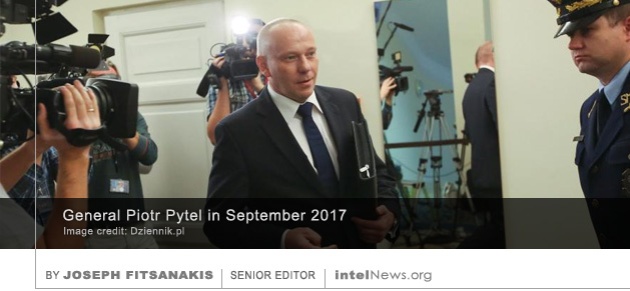
General Piotr Pytel

The former director of Poland’s military counterintelligence agency has been questioned by the country’s military police, over allegedly illegal cooperation with Russian intelligence. From 2006 to 2012, General Piotr Pytel was head of Poland’s Military Counterintelligence Service (MCS), which is responsible for domestic security and for ensuring the war-readiness of Poland’s armed forces. According to government prosecutors, General Pytel struck an illegal agreement with the Russian Federal Security Service, the FSB, in 2010. The alleged agreement concerned the return to Poland of troops who had been sent to serve in Afghanistan with the International Security Assistance Force (ISAF). Several hundred Polish troops participated in ISAF, a NATO-led security mission in Afghanistan, established by the United Nations Security Council in 2001.
General Pytel’s critics claim that he reached out to the FSB without authorization, and struck an agreement allowing for the passage of Polish troops through Russian soil on their way back to Poland from Central Asia. Some in the Polish government claim that the passage of Polish troops through Russia allowed the Russian spy services to collect intelligence on the Polish armed forces and thus weakened the Polish military vis-à-vis Russia. Polish authorities also accuse Genera Pytel’s predecessor at the helm of the MCS, General Janusz Nosek, of striking similar agreements with Moscow. These agreements were not authorized by NATO or the Polish high command and thus exceeded the prerogative of the MCS directors, according to prosecutors. The same prosecutors also questioned Donald Tusk, the current President of the European Council, who was Prime Minister of Poland in 2010. Mr. Tusk is also suspected of colluding with the Russian FSB, according to some reports.
But Mr. Tusk, and Generals Pytel and Nosek, deny that they engaged in illegal dealings with Russia and accuse the Polish prosecutor’s office of engaging in a political witch-hunt. All three of the accused belong to the Civil Platform, a liberal political party that is now in opposition but was the ruling party in the country from 2007 to 2015. Members of the Civil Platform have accused the Minister of Defense, Antoni Macierewicz, a member of the ruling conservative Law and Justice party (PiS), of politically persecuting his opponents. In statements made on social media on Wednesday, Mr. Tusk said he was proud to have worked with the two MCS former directors, whom he described “shining example[s] of responsibility, patriotism and honor”. He also called for Minister of Defense Macierewicz to resign.