Thursday, October 12, 2017

British IS recruiter Sally Jones killed in Syria drone strike

British jihadi Sally Jones, one of Islamic State's top recruiters, is alive and trying to escape from the Syrian city of Raqqa
Jones became known as the White Widow after the death of her husband
 
The former punk rocker from Kent fled to Syria with her son in 2013 and became a leading recruitment officer for Islamic State.
The Government was informed by CIA chiefs in June that US forces had killed Jones, 50, in a missile strike close to the Iraq/Syria border, The Sun reports.
However, it was kept secret on both sides of the Atlantic over fears her 12-year-old son Jojo may have also died in the blast.
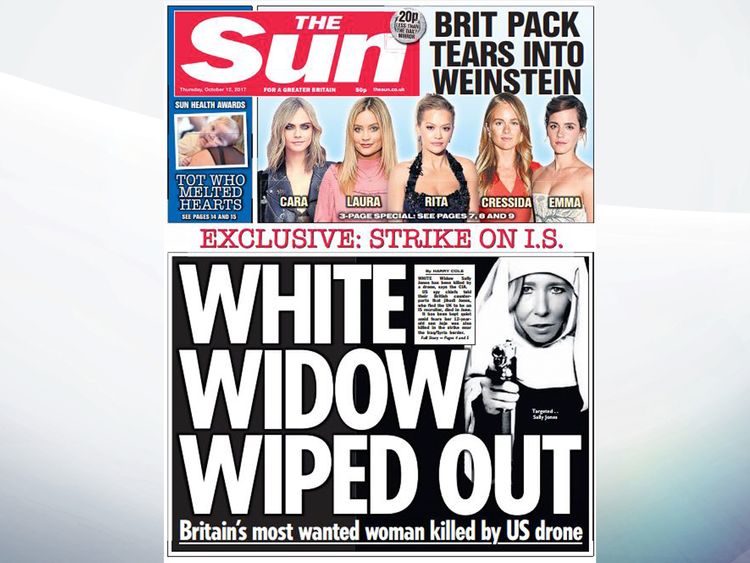
The Sun says Britain's most wanted woman, Sally Jones, has been killed in a drone strike
The CIA informed No 10 about the attack in June, according to The Sun
 
It remains unclear if he was killed and sources said the attack would have been aborted if it was known he was close by, the newspaper added.
Sky's Defence Correspondent Alistair Bunkall said: "UK Defence sources have told Sky News they believe the strike was successful but question some of the detail being reported in the media.
"The UK and US military has been working closely together on a number of high-profile targets in recent months and Jones is believed to have been on that list."
Jones became known as the White Widow after her British jihadist husband Junaid Hussain was killed in a US drone strike in August 2015.
Before fleeing to Syria, computer hacker Hussain admitted publishing Tony Blair's address in 2011 and was jailed for six months after making hoax calls to a UK counter-terror hotline a year later.

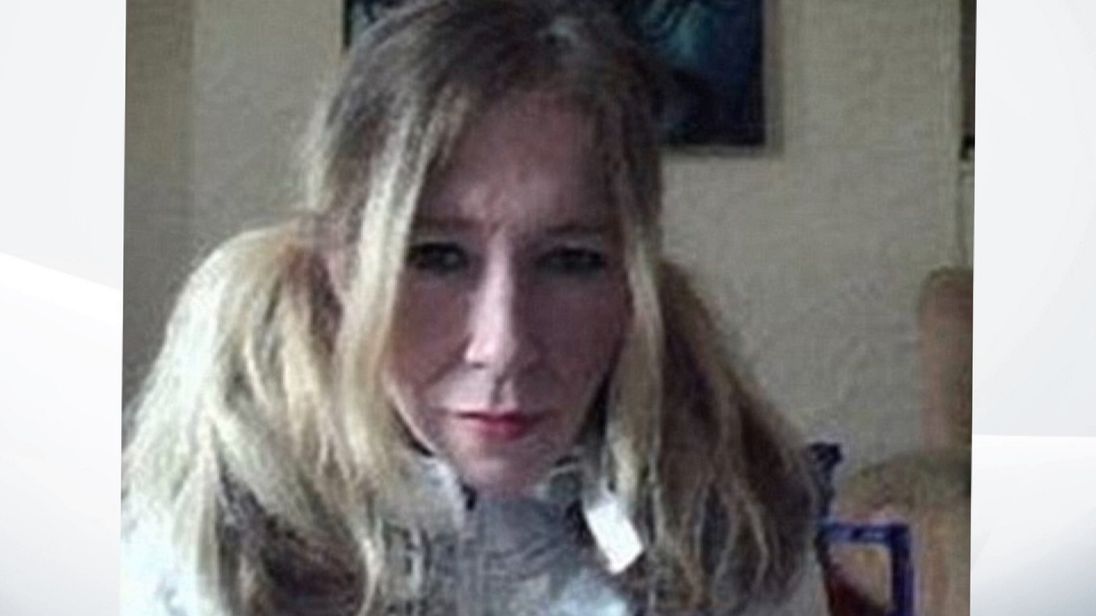
IS recruiter Sally Jones is known to be alive in Raqqa
IS recruiter Sally Jones fled to Syria in 2013


At the time of his death, the 21-year-old from Birmingham had allegedly been planning "barbaric attacks against the West", including terror plots targeting "high profile public commemorations".
In an exclusive report in 2015, Sky News revealed the couple used online messaging services to urge British would-be recruits to carry out "lone wolf" attacks in the UK.
In one conversation with an undercover journalist, Jones detailed the materials needed to make a bomb and said she could help construct a device remotely.
Following the death of Hussain, Jones was reportedly placed in charge of the female wing of IS' Anwar al-Awlaki batallion - a foreign fighter unit formed with the purpose of planning and executing attacks in the West.
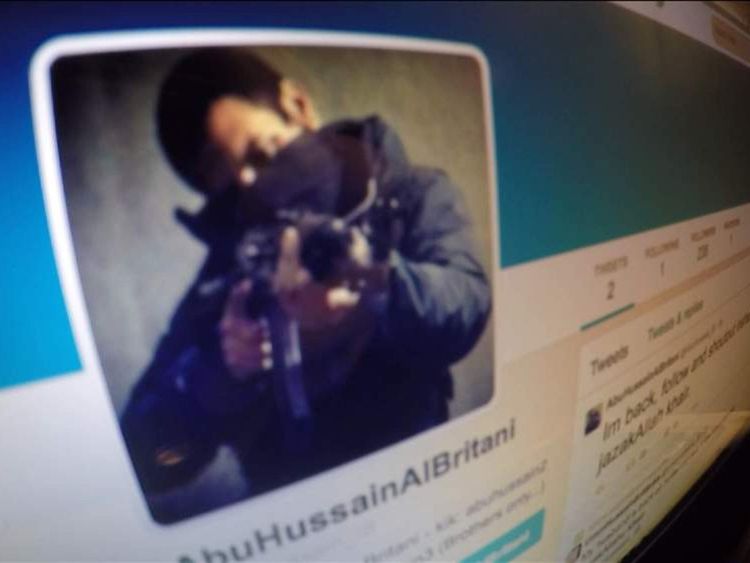
The 50-year-old used her Twitter account to recruit women and shared pictures of herself with weapons.
 Junaid Hussain

Hussain was killed in a US drone strike in August 2015


She also posted comments such as: "You Christians all need beheading with a nice blunt knife and stuck on the railings at Raqqa ... Come here I'll do it for you."
Despite this, Sky News was told in June that the jihadist was not happy in Syria and wanted to return to Britain.
The wife of another immigrant to the so-called Islamic caliphate said she knew Jones and described her as "very cute".
She added: "(Jones) was crying and wants to get back to Britain but ISIS is preventing her because she is now a military wife. She told me she wish to go to her country."
Major General Chip Chapman, the former MoD head of counter terror, told Sky News that Jones was a "significant" target for the US and UK.

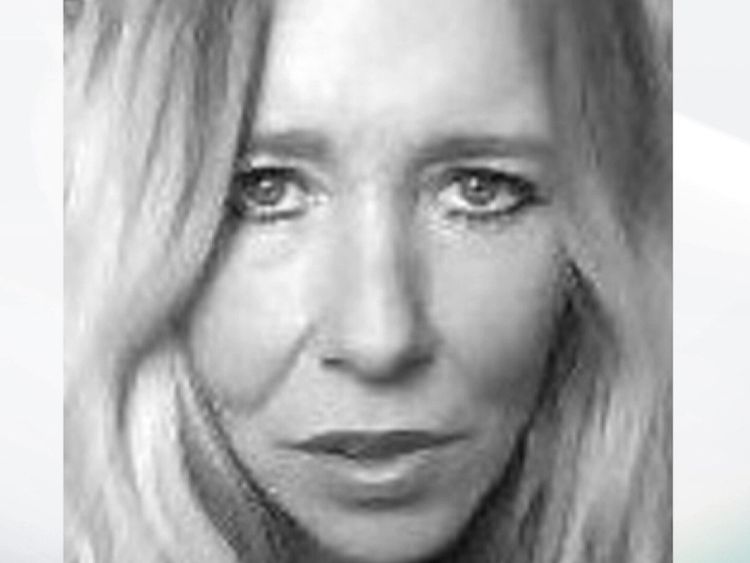
Former punk rocker Jones became a leading IS recruiter
 Former punk rocker Jones became a leading IS recruiter


He said: "Recently IS have said women should get involved in jihad - that's a sign of weakness.
"If you take out those who are high value target women it is going to have an impact at the operation level of IS."
Asked about reports Jones' son was killed in the strike, Maj Gen Chapman added: "It is a difficult one because under the UN Charters he is under the age of what we would classify as a soldier."
He continued: "Even if he got up to really bad things, he shouldn't have been targeted. We don't know for sure whether he was with her or not."

http://news.sky.com/story/british-is-recruiter-sally-jones-killed-in-syria-airstrike-the-sun-reports-11076814

Tuesday, September 12, 2017

French police officer charged in complex spy case involving Morocco, Algeria

Paris Orly Airport

A French police officer has been charged with illegally sharing secret government documents in an espionage case involving France’s border police and diplomats from Morocco and Algeria. According to information published by the French daily Libération, the police officer supplied Moroccan intelligence with classified information about France’s border-control policies and procedures. He also gave the Moroccans information about the movements in France of Moroccan nationals and senior Algerian government officials.

According to the report by Libération, the police officer, identified only as “Charles D.”, was charged on May 31 of this year with corruption and violating secrecy rules. Court documents state that Charles D. gave away classified documents belonging to the Direction centrale de la police aux frontières (DCPAF), a directorate of the French National Police that is in charge of immigration control and border protection across France. He reportedly gave the documents to another man, identified in court documents as “Driss A.”, who worked at Paris’ Orly Airport. It is believed that Driss A. worked as director of the Orly branch of ICTS International, a Dutch-based company that provides security services in several European airports. It is also believed that Driss A. —a Moroccan-born French citizen— was secretly employed by the Deuxième Bureau, Morocco’s military intelligence service. It appears that the Moroccans compensated Charles D with free holidays in Morocco in exchange for his services.

Interestingly, when French counterintelligence officers raided Driss A.’s home in Paris, they found documents detailing the activities of senior Algerian government ministers during their official trips to France. The officials are identified in the documents as Algeria’s former Deputy Prime Minister Noureddine Yazid Zerhouni, Higher Education Minister Tahar Hadjar, and Telecommunications Minister Hamid Grine. The documents appear to have been produced by Algerian intelligence and given initially to the embassy of Algeria in France. No explanation has been given about how these documents fell in Driss A.’s possession. Some observers assume that Driss A., acting as a Moroccan intelligence operative, must have acquired them from a source inside the Algerian embassy in Paris.

https://intelnews.org/2017/09/07/01-2171/

Alleged Israeli spying device concealed inside fake rock found in Lebanon

Cyprus, Israel, Syria, Lebanon

A sophisticated spying device disguised as a rock, which was allegedly planted by Israeli intelligence, was found by Lebanese Army troops on a hill located a few miles from the Lebanese-Israeli border. The discovery was reported early on Saturday by several Lebanese news websites, including Al-Mayadeen and Al-Manar, which are closely affiliated with Hezbollah. Al-Manar said that the spy device had been found in the outskirts of Kfarchouba, a predominantly Shiite Lebanese village, located in Arkoub, 100 miles southeast of Lebanon’s capital, Beirut. Kfarchouba’s location is extremely strategic, as the village overlooks northern Israel on the south and the Golan Heights on the east. It has been bombed by Israel several dimes between the 1970s and today, and is remains heavily militarized.

Reports from Lebanon said that a Lebanese Army patrol found the device hidden inside a fake rock, which had been placed on a hill outside Kfarchouba. The device had been placed in direct view of a major Lebanese military outpost, known as Rawisat. As soon as the device was detected, the patrol reportedly called in the Lebanese Army’s intelligence corps for support. Technical experts soon examined the discovery and determined that it contained a sophisticated thermographic camera. Also known as infrared or thermal imaging cameras, thermographic cameras capture images using infrared radiation, instead of using visible light, as is the case with commonly used cameras. This allows them to capture relatively clear images in the darkness, and are thus used for military operations that require night vision. Some Lebanese websites published photographs showing parts of the alleged spy device, which appear to bear writing in Hebrew.

This is not the first time that alleged Israeli spy devices have been found in southern Lebanon. In September of 2014, one person was killed when a mysterious device found near the Lebanese village of Adloun suddenly exploded as Hezbollah troops were examining it. It was later suggested that the device had been attached by Israeli troops to the Hezbollah-owned telecommunications network that spans southern Lebanon. Hezbollah said that the device had been remotely detonated by an Israeli drone in order to prevent it from being reverse-engineered. Two other devices found by a Lebanese Army patrol in the same region in October of 2009 suddenly exploded, as Lebanese security personnel were approaching. A Lebanese Army official said on Sunday that the device found in Kfarchouba will be dismantled by Lebanese Army engineers.

Ex-spy chef jailed as elite power struggle widens in oil-rich Kazakhstan

The Tengiz oil refinery in Kazakhstan

 A former director of Kazakhstan’s feared intelligence agency has been given a lengthy prison sentence, as a ruthless power struggle between rival factions surrounding the country’s president widens. From 2001 to 2006, Nartai Dutbayev directed the Kazakh National Security Committee (KNB), a direct institutional descendant of the Soviet-era KGB. Founded in 1992, the KNB is today directly controlled by Kazakhstan’s authoritarian President, Nursultan Nazarbayev. Many officials serving in senior KNB positions are members of the president’s family, or close friends.

For many years, Dutbayev enjoyed unchallenged power, which was afforded to him by way of his close links to the presidential palace. But in 2006, he resigned from his top KNB post in the aftermath of the murder of popular Kazakh opposition politician Altynbek Sarsenbaev. Ten members of a specialist commando unit within the KNB were found guilty of Sarsenbaev’s murder. He was killed soon after he announced his decision to compete electorally against President Nazarbayev. But Dutbayev was never personally censured by the government. Then, in December of last year, Dutbayev was arrested on charges of “divulging government secrets”. The former spy chief’s trial began in July of this year, but was conducted in its entirety behind closed doors.
This past Monday it was reported that Dutbayev was sentenced to 7 ½ years in prison for espionage on August 24. It is not known why Dutbayev’s sentence was announced to the country’s media more than two weeks after it was formally imposed by the court. Additionally, Kazakh authorities have said nothing about who Dutbayev is believed to have divulged government secrets to, or why. Three alleged accomplices of Dutbayev, including former senior KNB officials Erlan Nurtaev and Nurlan Khasen, were also sentenced to between three and five years in prison for espionage.
Many observers believe that the jailing of the KNB officials is part of a broader power struggle that is currently taking place between rival factions competing to succeed President Nazarbayev. Kazakhstan’s leader has ruled the former Soviet Republic with an iron fist since before its independence from the USSR in 1991. The KNB appears to be a central player in the unfolding power struggle between the country’s governing elites. Almost exactly nine years ago, a Kazakh intelligence officer tried unsuccessfully to abduct another KNB former director, Alnur Musaev, who was living in self-imposed exile in Austria at the time. Many believe that he was acting under Nazarbayev’s direct orders. In 2014, two Kazakh men, believed to be KNB officers, tried unsuccessfully to abduct Viktor Khrapunov, Kazakhstan’s former Minister for Energy and Coal, who also served as mayor of Almati, before leaving Kazakhstan for Switzerland.
Dutbayev is reportedly already in prison. He is believed to be sharing a cell with Serik Akhmetov, Kazakhstan’s former prime minister, who is serving 11 years for alleged corruption.

Thursday, July 13, 2017

Photos show US, South Korean, and Japanese aircraft on mission to flex on North Korea after ICBM test

us air force b-1b
A US Air Force B-1B Lancer prepares for takeoff from Andersen Air Force Base in Guam to conduct a mission with South Korean F-15, and Japan Air Self-Defense Force F-2 fighter jets, July 7.


Three days after North Korea demonstrated its ability to hit the US with long-range nuclear missiles, the US, South Korea, and Japan put on a display of air power expressly meant to frighten Kim Jong Un.

Flying 10 hours from Guam to the Korean peninsula, US B-1 Lancer bombers joined up with South Korean F-15s and dropped dud bombs at a range near the demilitarized border between North and South Korea. On the way back, Japanese F-2 fighters escorted the US heavy bombers.

"North Korea’s actions are a threat to our allies, partners and homeland," Gen. Terrence O’ Shaughnessy, Pacific Air Forces commander, said in a statement. "Let me be clear, if called upon we are trained, equipped and ready to unleash the full lethal capability of our allied air forces."

In the pictures below, see how the US and its allies train to respond to North Korea.

The B-1 was originally designed to carry nuclear weapons but is no longer able to. But it can carry more conventional bombs than any US Air Force plane and fly at mach 1.2.

The B-1 was originally designed to carry nuclear weapons but is no longer able to. But it can carry more conventional bombs than any US Air Force plane and fly at mach 1.2.
US Air Force Photo by Tech. Sgt. Richard P. Ebensberger
 

Due to tensions in the Pacific, the US maintains a constant bomber presence in Guam.

Due to tensions in the Pacific, the US maintains a constant bomber presence in Guam.
US Air Force Photo by Airman 1st Class Jacob Skovo
 

Here's the US and South Korea sending a strong bilateral message to Kim Jong Un.

Here's the US and South Korea sending a strong bilateral message to Kim Jong Un. 
 
US Air Force B-1B Lancers fly with South Korean F-15 and US Air Force F-16 fighter jets over the Korean Peninsula, July 7.Republic of Korea air force
 
The US frequently flies over Korea with heavy bombers to signal resolve, but this time the Air Force stepped it up by dropping inert bombs near the DMZ.
Inert weapons dropped from US Air Force B-1B Lancers practicing attack capabilities land on the Pilsung Range, July 7.US Army photo by Staff Sgt. Steven Schneider

On the way back, Japanese F-2s escorted the B-1s.

On the way back, Japanese F-2s escorted the B-1s.
Two US Air Force B-1B Lancers fly with a Koku Jieitai (Japan Air Self-Defense Force) F-2 fighter jet over the East China Sea, July 7
 

Russian security firm Kaspersky denies spy agency work

Eugene Kaspersky
Eugene Kaspersky founded Kaspersky Lab in 1997  

Moscow-based security company Kaspersky Lab has denied working with Russian intelligence agencies, following US media and government suspicion.

News website Bloomberg said it had seen emails showing Kaspersky had developed tools for Russia's intelligence agency.

And, on Tuesday, the US government's General Services Administration removed Kaspersky Lab from a list of approved vendors.

But the company has now insisted it has "no ties to any government".

Kaspersky Lab is known for its anti-virus software and provides cyber-security products to businesses.

Bloomberg reported it had seen emails between chief executive Eugene Kaspersky and senior Kaspersky staff, outlining a secret cyber-security project apparently requested by the Russian intelligence service FSB.

In the emails Mr Kaspersky describes tools to "protect against attacks" and also engage "active countermeasures".

Bloomberg suggested that the tools not only deflected cyber-attacks, but also captured information about the hackers launching them, to pass on to Russian intelligence services.

In the emails, Mr Kaspersky said the software could one day be sold to corporate customers worldwide.

Refuting the claims, Kaspersky Lab said: "The communication was misinterpreted or manipulated to try to make the media outlet's narrative work.

"Kaspersky Lab is very public about the fact that it assists law enforcement agencies around the world with fighting cyber-threats, including those in Russia, by providing cyber-security expertise on malware and cyber-attacks."

However, the US General Services Administration said it had removed Kaspersky Lab from its list of government-approved suppliers "after review and careful consideration".

In a further statement, Kaspersky Lab said: "The company has never helped, nor will help, any government in the world with its cyber-espionage efforts.

"Kaspersky Lab believes it is completely unacceptable that the company is being unjustly accused without any hard evidence to back up these false allegations."

In the statement, Mr Kaspersky offered to meet US government officials and provide his company's software code for audit.

"Kaspersky Lab, a private company, seems to be caught in the middle of a geopolitical fight where each side is attempting to use the company as a pawn in their political game," the company said.

The Trump administration has been fighting allegations that it had contact with Russian officials during the US election in 2016.

http://www.bbc.co.uk/news/technology-40580896

The US had a clear shot at killing Kim Jong-un on 4 July - here's why it didn't strike

kim-jong-un.jpg

When North Korea launched its first intercontinental ballistic missile in the early-morning hours of 4 July, US military and intelligence personnel watched for a full 70 minutes, a source told The Diplomat's Ankit Panda.

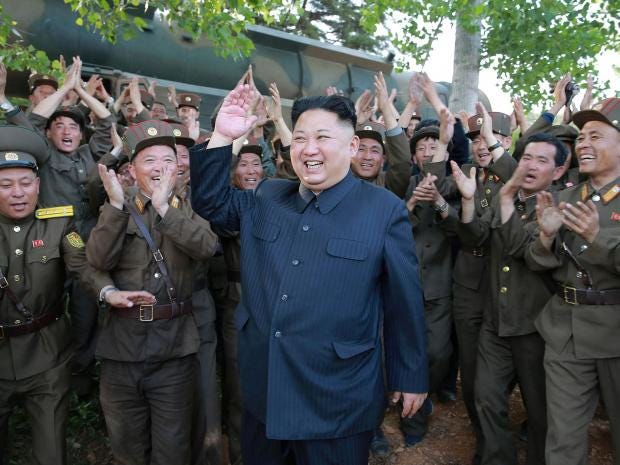
During that time, North Korean leader Kim Jong-un smoked cigarettes and strolled around the launchpad under the US's gaze.

The US knew North Korea was in the final stages of building an ICBM after a recent rocket-engine test. The US knew North Korea liked to test missiles on the American Independence Day to send a message. The US knew this missile was different from any it had seen before, and the US knew it could destroy it with a variety of precision-fire platforms in the region. Importantly, the US also had Kim in its crosshairs for over an hour — and did nothing.

Those facts speak volumes about the security climate in the Koreas.
While it's “fairly standard that the US didn't strike the missile ahead of the launch,” Rodger Baker, the lead analyst of Asia Pacific and South Asia at Stratfor, a geopolitical consulting firm, told Business Insider, “the unusual aspect may be saying they were watching, or at least allowing that to leak.”

Video of the launch clearly shows Kim on-site, sometimes feet away from the missile. The next day, the US and South Korea put on a blistering display of precision-guided firepower demonstrating they could have both killed Kim and stopped the launch. But they didn’t.

By letting North Korea know it watched Kim as he prepared for one of his country's most provocative missile tests ever, Baker says, the US may have sent two powerful messages.

The decision fit with Secretary of State Rex Tillerson's statement that the US wanted “to bring Kim Jong-un to his senses, not his knees” and that regime change was not the US's ultimate goal.
But regime security is the reason North Korea wants long-range nuclear weapons in the first place.
If the US demonstrates it's not intent on killing Kim, that could communicate that there's “no need to continue” the missile programme, according to Baker.

But “if the program is continued,” Baker said, the US showed it could “strike it and Kim.” Though North Korea varies and tries to hide its launch points, the US tracks them vigorously, and footage of the launches always shows Kim nearby.

Perhaps rather than kill Kim and trigger a North Korean response, which could be massive, the US elected to signal that the best path to regime security would be to stay indoors and not play around near dangerous rocket engines, which have a habit of blowing up.

http://www.independent.co.uk/news/world/asia/north-korea-kim-jong-un-us-assassination-4-july-missile-launch-testing-a7837176.html