Tuesday, November 22, 2016

ISIS Used Chemical Arms at Least 52 Times in Syria and Iraq


A cemetery on the outskirts of Gaziantep, Turkey. Grave No. 38487 holds the body of a 4-year-old girl who died of wounds she received when a shell containing sulfur mustard agent hit her home in Marea, Syria.

The Islamic State has used chemical weapons, including chlorine and sulfur mustard agents, at least 52 times on the battlefield in Syria and Iraq since it swept to power in 2014, according to a new independent analysis.
More than one-third of those chemical attacks have come in and around Mosul, the Islamic State stronghold in northern Iraq, according to the assessment by the IHS Conflict Monitor, a London-based intelligence collection and analysis service.
The IHS conclusions, which are based on local news reports, social media and Islamic State propaganda, mark the broadest compilation of chemical attacks in the conflict. American and Iraqi military officials have expressed growing alarm over the prospect of additional chemical attacks as the allies press to regain both Mosul and Raqqa, the Islamic State capital in Syria.
“The coalition is concerned about ISIL’s use of chemical weapons,” Col. John Dorrian, a military spokesman in Iraq, said in an email on Monday, using another name for the Islamic State. “ISIL has used them in Iraq and Syria in the past, and we expect them to continue employing these types of weapons.”
Colonel Dorrian said that the Islamic State’s ability to use chemical weapons is “rudimentary,” and that American, Iraqi and other allied troops are equipped to deal with the impact of these chemical attacks — typically rockets, mortar shells or artillery shells filled with chemical agents. The effects of these chemical munitions thus far have been limited to the immediate area where they land.
The IHS assessment is to be made public on Tuesday. The New York Times obtained an advance copy of the assessment and the location of the 52 reported chemical attacks. The analysis did not break down the cases by type of chemical attack.
In an effort to blunt the Islamic State’s ability to make the weapons, the American-led air campaign has bombed militants associated with overseeing their production and the facilities where chemical ordnance is manufactured. In September, for instance, allied warplanes attacked a converted pharmaceutical factory in northern Iraq thought to have been a chemical weapons production facility.
As Iraqi forces now advance into Mosul, analysts warned that the Islamic State could unleash more chemical attacks as they cede control. Iraqi forces have reclaimed about one-third of Mosul, Iraq’s second-largest city.
“As the Islamic State loses ground around Mosul, there is a high risk of the group using chemical weapons to slow down and demoralize advancing enemy forces.” said Columb Strack, a senior analyst and the head of the IHS Conflict Monitor. “And to potentially make an example of — and take revenge on — civilian dissidents within the city.”
At least 19 of the 52 chemical attacks have taken place in and around Mosul, according to the IHS data, but the assessment noted a decline in attacks before the Iraqi-led offensive against the city.
“Mosul was at the center of the Islamic State’s chemical weapons production,” Mr. Strack said. “But most of the equipment and experts were probably evacuated to Syria in the weeks and months leading up to the Mosul offensive, along with convoys of other senior members and their families.”
The Islamic State is not the only actor in Syria to carry out chemical weapons’ strikes: The Syrian government has conducted many more such attacks.
Syrian military helicopters dropped bombs containing chlorine on civilians in at least two attacks over the past two years, a special joint investigation of the United Nations and an international chemical weapons monitor said in August.
Beginning last year, American officials confirmed the first instances of the Islamic State using sulfur mustard, a chemical warfare agent, and the presence of the mustard gas on fragments of ordnance used in attacks by the group in Syria and Iraq. Laboratory tests, which were also performed on scraps of clothing from victims, showed the presence of a partly degraded form of distilled sulfur mustard, an internationally banned substance that burns a victim’s skin, breathing passages and eyes.
Chemical warfare agents, broadly condemned and banned by most nations under international convention, are indiscriminate. They are also difficult to defend against without specialized equipment, which many of the Islamic State’s foes in Iraq and Syria lack. The chemical agents are worrisome as potential terrorist weapons, even though chlorine and blister agents are typically less lethal than bullets, shrapnel or explosives.
It was unclear how the Islamic State had obtained sulfur mustard, a banned substance with a narrow chemical warfare application. Both the former Hussein government in Iraq and the current government in Syria at one point possessed chemical warfare programs.
Chlorine is commercially available as an industrial chemical and has been used occasionally by bomb makers from Sunni militant groups in Iraq for about a decade. But it is not known how the Islamic State would have obtained sulfur mustard, the officials said.
Abandoned and aging chemical munitions produced by Iraq during its war against Iran in the 1980s were used in roadside bombs against American forces during the occupation that followed the 2003 American invasion of Iraq. But American officials have said the types of ordnance that have been publicly disclosed so far have not matched known chemical ordnance in the former Iraqi inventory.
The attacks have been geographically scattered and have varied in their delivery systems, suggesting that the Islamic State had access to, and was experimenting with, different types of rockets and shells configured to carry chemical warfare agents or toxic industrial chemicals.
One theory is that the militants were manufacturing a crude mustard agent themselves, American officials say. Another theory is that the Islamic State acquired sulfur mustard from undeclared stocks in Syria, either through capture or by purchasing it from corrupt officials, although this theory is not widely held by American analysts.

http://www.nytimes.com/2016/11/21/world/middleeast/isis-chemical-weapons-syria-iraq-mosul.html?_r=0 
 

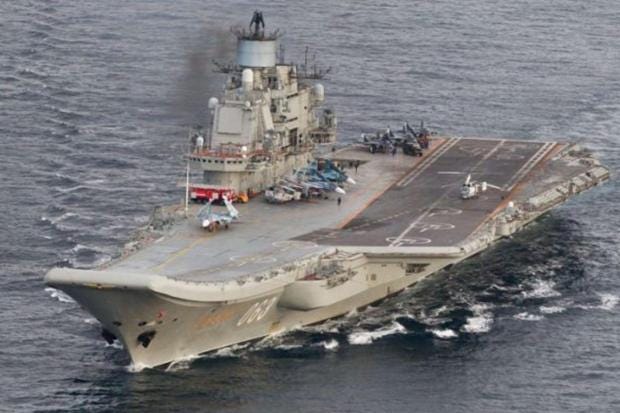
The Russian Media Outlet Lenta.ru Tells The Story Of Russia's Lone Aircraft Carrier, The Admiral Kuznetsov


"On 21 July 1970, in the Chernomorskiy Shipyard, the largest Soviet shipyard, situated in Nikolayev, the lead ship of Project 1143 was laid down — an antisubmarine cruiser with aircraft armament, which was named Kiev. It was intended to become the first Soviet aircraft carrier – i. e. a ship designed for aircraft landings and take-offs directly from the deck. The specific characteristics of this project were the result of a difficult intra-Soviet compromise, which found expression in everything including classification. Post factum, the definition 'antisubmarine cruiser with aircraft armament,' later exchanged for 'heavy aircraft-carrying cruiser,' can be explained inter alia by a desire, to avoid problems with passage through the Black Sea straits, but these explanations are false: firstly, the Montreux Convention  does not incorporate a direct ban on passage through the straits of aircraft carriers of litoral Black Sea states; secondly, in the Western classification (used among others by Turkey, which controlled the straits), including the classification used in addendums to the Montreux Convention, Kiev and its descendants were always clearly defined as aircraft carriers.
"The reason for these classification tricks was purely internal: it was impossible, in the context of Soviet ideological reality, to announce directly the construction of ships that were at the same time branded by the [Soviet] press as 'tools of aggressive war.'
"To a large extent, the same reasons defined the ship's characteristics: it was a hybrid that overcame the hurdles put in its way by numerous opponents of aircraft carriers as a vessel class. The hybrid was designed for the deployment of vertical take-off and landing (VTOL) aircraft and helicopters, but with a cruiser's missile munitions and the size of an 'aircraft carrier'. With a 37 thousand ton standard displacement, a 273 meter length, and a 180 thousand horsepower steam turbine propulsion system, Kiev could be placed somewhere between the French Foch and Clemenceau-class aircraft carriers with a standard displacement of approximately 30 thousand tons and a length of 265 meters, and the 45 thousand ton American Midways.
"In contrast to those ships, Kiev lacked a full deck – its bow contained cruiser fighting equipment, which restricted its aircraft carrying capabilities to operating VTOL aircraft, just like the much smaller British Invincible-class ships, which were designed at that time.
"The biggest problems of Project 1143 were related to the air group: the Yak-38, a subsonic VTOL plane with weak weapons and a relatively small action radius, looked odd on a ship equipped with anti-ship missiles with a range of up to 500 km. In fact, the Yak-38, officially classified as a strike fighter, could not perform any of the truly critical tasks: as a strike aircraft it was useless in anti-fleet operations since it did not have missiles that would allow it to attack ships, and as part of air defense forces its chances would be slim in a confrontation with the enemy's strike machines operating under supersonic fighter cover.
"Kiev's shortcomings were obvious, so new alternatives were considered.
'Any Detailed Development Of Project 1160 Was Never Started. Instead Of A New Aircraft Carrier, It Was Decided To Continue Series 1143'
"The chief alternative was the project assigned the number 1160. It contained some compromise solutions, such as anti-ship missile launchers, but it was a full-fledged aircraft carrier project. Nuclear propulsion system, 72 thousand ton standard and 80 – full displacement, full deck,  an aircraft system that included an angled deck, four steam catapults, and arresting gear – all this made it a fully functional analogue of American super aircraft carriers.
"As for the air group, there were plans to use MiG-23A Molniya (Lightning) aircraft (the deck-based variant of the newest contemporary Soviet frontline fighter), Su-24K missile bombers (the deck-based variant of a strike aircraft that was being developed at the time), P-42 anti-submarine defense aircraft specially designed for aircraft carriers by the Beriev design bureau, as well as 'flying radars' based on the latter, and helicopters. As planes developed, plans changed: in 1973, there were suggestions to use deck-based variants of Su-27 and MiG-29 that were being developed then.

Project 1160 aircraft carrier, a variant (Source: Lenta.ru)
"The creation of this ship required solving a number of process tasks, the chief of which was the development of arresting gear and steam catapults – devices that Soviet industry had not previously produced. There is no doubt that these systems could be produced in 1970s – the USSR already disposed of all the necessary technologies by that time.
"Nevertheless, any detailed development of Project 1160 was never started. Instead of a new aircraft carrier, it was decided to continue Series 1143. In 1972, another Project 1143 ship was laid down — the heavy aircraft-carrying cruiser Minsk, and in 1975 – Novorossiysk.
'The Navy Did Not Abandon The Attempts To Obtain A Ship Capable Of Taking Conventional Take-Off And Landing Aircraft'
"Supporters of the aircraft carrier idea, with the backing of ministers of defense and shipbuilding industry and the interest of the Commander-in-Chief of the Russian navy, continued to propose new variants. In 1973, on the basis of the groundwork done on Project 1160, the Nevskoye design bureau started developing Project 1153 – an atomic CATOBAR (Catapult Take-off But Arrested Recovery) aircraft carrier similar to 1160— with catapults and arresting gear but smaller in size and cheaper, with two catapults instead of four. This project, however, was also supposed to carry anti-ship missiles, and the air group was supposed to consist of 50 aircraft (at 60 thousand ton standard displacement).
"The building of the ship was supposed to start in 1978, but in 1976, the aircraft carrier lobby lost two of its major figures: the minister of defense Andrey Grechko died on April 26, and the minister of shipbuilding industry Boris Butoma – on July 11. At the insistence of the new head of the military department, Dmitri Ustinov, Series 1143 was extended with the fourth ship – heavy aircraft-carrying cruiser Baku.

Project 1153 aircraft carrier, possible general view (Source: Lenta.ru)
 
"Nevertheless, the navy did not abandon the attempts to obtain a ship tailored for conventional take-off and landing aircraft. The Nevskoye design bureau began developing a new aircraft carrier project, as near as possible to Project 1143 in general ship systems – to remove at least the cost obstacle to the development of a new ship.
"On September 1, 1982, in the Chernomorskiy Shipyard, the fifth ship of Project 1143 was laid down — heavy aircraft-carrying cruiser Riga. It was the result of a compromise between the desire to finally have a normal aircraft carrier and the pressure of the 'anti-aircraft carrier' lobby that consented only to modifications of Project 1143. From the technical perspective, Project 1143.5 was a hybrid of preliminary work done in Project 1153 and the "Order" research and development project, planted onto the source base of Project 1143.
"In size, 1143.5 with its 55 thousand ton standard displacement was not much smaller than 1153 and considerably larger than its predecessors. The large deck and elevator area facilitated the use of heavy and large Su-27-based machines, but catapults were removed from the project – instead, a ski-jump ramp was supposed to be used to allow shorter take-off run.
"Gone too was the nuclear propulsion system and instead, Riga (which soon afterwards was renamed the Leonid Brezhnev, following the Secretary General's death) got a steam turbine system consisting of four TB-12 geared-turbine units and eight KVG-4 boilers with a total capacity of 200 thousand horsepower. This variant of propulsion system determined the future of the ship, which was renamed Tbilisi after its launching in 1985, and then, in 1990, with the collapse of the USSR already on the horizon, — Admiral Flota Sovetskogo Soyuza Kuznetsov
'In Order To Make The Creation Of Aircraft Carriers Of The New Generation Possible, The Navy Must Keep And Repair Admiral Kuznetsov'
"Admiral Kuznetsov could not help being a problematic ship – its introduction into service coincided with the disintegration of the country and was accompanied by serious organizational problems, one of which was the uncertainty of its future: in autumn 1991, Russian navy command seriously contemplated as a threat the scenario of the ship being hijacked in Sevastopol by Ukrainian separatists who were rather popular even in the Black Sea Fleet.
"The result was Kuznetsov's secret and hasty departure from the Black Sea to the Northern Fleet, even though some of the works had not yet been completed, including works on the propulsion system.
"The ship's deployment in the Kola Bay removed the worries over its nationality, but did not contribute to its normal introduction to service: most of the technical experts, whose absence rendered the aircraft carrier's maintenance highly problematic remained at the Black Sea. Partially, these problems were solved by the fact that heavy aircraft-carrying cruisers Kiev and Admiral Gorshkov (until 1990 named Baku) were part of the Northern Fleet as well. They had propulsion systems almost identical to that of Kuznetsov, but severe reductions in military expenditures and the transfer of these ships from the first line to the reserve with the accompanying crew size reduction did not improve the situation.
"In 1993, the first three ships of Project 1143 — Kiev and the Pacific Ocean-based Minsk and Novorossiysk were withdrawn from the navy for good. In 1994, the navy lost Admiral Gorshkov as well; by that time, it had been laid up for repairs after a fire in the aft engine-boiler room. In Nikolayev, works on Kuznetsov's sister ship – the heavy aircraft-carrying cruiser Varyag (laid down in 1985 under the name Riga and renamed in 1990) – were stopped. The last ship of the 1143–1143.7 family, named Ulyanovsk, was scrapped in the Nikolayev shipyard in 1993, when it was 20% ready. Further fate of these ships was different in each case. The most interesting was the story of Gorshkov and Varyag: the former, after a long reconstruction in Severodvinsk was given to India in 2013 as the aircraft carrier Vikramaditya; the latter was sold by Ukraine to China in 1998 at the price of scrap metal, and about 15 years later became the aircraft carrier Liaoning.

The launching of Riga, renamed Varyag (Source: Lenta.ru)
 
"As for Ulyanovsk, which was laid down in 1988, when ideological dogmas were no longer a fixed part of the Soviet military construction, it was the closest to a full-fledged aircraft carrier – a hybrid with simultaneous use of a ski-jump ramp in the bows and catapults on the angled deck; its large size and nuclear propulsion system made it similar in its capabilities to the unimplemented projects 1160 and 1153, as well as to American atomic aircraft carriers. However, it too had to carry anti-ship missiles.
"In 1995, it was decided to send Admiral Kuznetsov to the Mediterranean: the long-distance voyage was timed to coincide with the 300th anniversary of the Russian navy to be celebrated the year after. The first voyage could have been the last one – the breakdown of the propulsion unit nearly resulted in the loss of the ship during a storm. The aircraft carrier finished its voyage successfully and returned to the Kola Bay, but the condition of the technical systems of the engine-room department remains a source of major concern even now.
"Lack of funds for full repairs in 1990s — early 2000s, coupled with the shortage of skilled experts, made the ship's problems chronic. They could be partially solved by cannibalization – removing necessary parts from Project 956 destroyers, which used similar turbine-geared propulsion units and boilers; but this was not a comprehensive solution. Power problems significantly reduce the ship's performance, which affects the capabilities of its aircraft — for a take-off with maximum takeoff weight (i.e. maximum fuel supply and payload), the ship needs to put on full speed. The existing operating limitations result in a reduction of fuel supply and payload, which affects the aircraft's combat performance. Externally, the problems with the ship's propulsion system are expressed, among other things, by excessive smoking in some modes – according to some experts, the direct reason for smoke may be a defect of the automatic controls of the main propulsion machinery, which makes using optimal fuel combustion modes impossible.
"Problems with the propulsion system are only one part of Kuznetsov's shortcomings. The infrastructure degradation that went on for a long time, the air group that was always undermanned, and the general condition of the fleet that did not have enough funds for full combat training until 2000s, – all this resulted in the loss of a significant part of the aircraft carrier service experience acquired with previous ships.  Now, this experience has to be acquired anew, but the only Russian aircraft carrier has not grown any younger in the interim.
"The modernization and repairs of Admiral Kuznetsov, scheduled for the next few years, should fundamentally solve the ship's problems. But it's not enough to maintain carrier-based aviation as a system. The Russian navy still needs planes capable of providing cover for its deployment off the coast – primarily in order to defend its own sea borders in the Arctic and in the Pacific Ocean. But in order to make the creation of aircraft carriers of the new generation possible, the navy must keep and repair Admiral Kuznetsov. In this realm, no other source of human resources and technologies exists in Russia."


Wednesday, November 16, 2016

What is Taranis? Everything you need to know about Britain’s undetectable drone

Photo credit: BAE Systems

Unmanned aerial vehicles, known as drones, are changing the face of combat.
Whether they’re being used for surveillance or undertaking military offensives, the  increased use of military drones means we’re heading towards a future where pilots keep their feet on the ground in mission control.
Britain is at the centre of the race to create the ultimate unmanned, undetectable aircraft. Here’s what you need to know about Taranis.

What is Taranis?

Named after the Celtic god of thunder, Taranis is an unmanned aerial combat vehicle drone with stealth capabilities, built by BAE Systems for the MoD. The delta-winged, finless craft was unveiled in 2010 and made a number secretive test flights between 2013 and 2015. The cost of the programme is now thought to be in excess of £200 million.

What is its purpose?

The Taranis stealth drone was designed to demonstrate multiple surveillance and combat tasks that help shape the future of drone design. Tests conducted in the Australian desert have included complete stealth flight and simulated weapons release tests.

A post on the BAE website explains: “The aircraft was designed to demonstrate the UK’s ability to create an unmanned air system which, under the control of a human operator, is capable of undertaking sustained surveillance, marking targets, gathering intelligence, deterring adversaries and carrying out strikes in hostile territory.”

Will Taranis see combat?

No. The Taranis drone was built for demonstration purposes only, but it will inspire a fleet of aircraft that will someday see battle. However, as a result of the test, BAE says “the UK has developed a significant lead in understanding unmanned aircraft which could strike with precision over a long range whilst remaining undetected”.

How fast can Taranis fly?

The Taranis stealth drone, which has a wingspan of 10 metres, can hit speeds of 700mph - exceptionally close to breaking the sound barrier. If a supersonic, pilotless plane, undetectable by radar and carrying payload of weapons sounds scary, that’s because it is.

How is Taranis flown?

Taranis is flown by a specially trained ‘pilot’ who can manually control the craft from a remote location. However, it does have an autonomous flight mode in which it is trusted to ‘think’ and carry out missions of its own accord.
“It can self-navigate within a boundary of set constraints,” Jon Wiggall, the lead flight engineer said of Taranis earlier this year.
“It does have limitations on what we give it in the mission plan – it can only fly in certain areas – but it does think for itself, it will navigate, and it will search for targets.”
There’s also an automatic mode where it is programmed to follow a flight path.
Taranis

How does it fly under the radar?

There are a number of factors involved in the meeting of the stealth challenge, including the design and materials used in constructions.
The drone uses a secretive communication system that enables it to communicate with home base without giving away its position to would-be enemies.
BAE engineers were forced to redesign the engine inlet and exhaust in order to stop the engine’s thermal image betraying its presence to enemy radar. Conrad Banks, Rolls-Royce's chief engineer said in 2014 it was about “minimising any sign there is an engine there”.

But can Taranis achieve true stealth capability?

In May this year, Paddy Bourne, chief engineer for UCAVs at BAE refused to confirm whether Taranis had been able to completely avoid radar detection during tests. Referring to the Ministry of Defence, he said “the customer is very happy.”

What’s next for Taranis?

Right now it appears as though Taranis’s flying career is over. The data acquired from the trio of test flights is currently being analysed, and that knowledge will be fed into the development of new drones under the Anglo-French Future Combat Air System (AFFCAS). It’ll also inform how the RAF will use manned and unmanned jets in future combat situations.

So, what is the AFFCAS?

Britain and the EU may be breaking up, but we’re still playing nice with France when it comes to security. In March, following the completion of a feasibility study, the two countries announced a £1.5 billion bilateral agreement to build prototype combat drones. Full-scale development will begin in 2017.


Russian fighter jet crashes in Mediterranean sea near aircraft carrier that passed UK waters on way to Syria

admiral-kuznetsov.jpg

A Russian fighter jet crashed in the Mediterranean Sea near the coast of Syria after taking off from the flagship Admiral Kuznetsov aircraft carrier.

Three MiG-29 jets took off from the Soviet-era aircraft carrier and flew in the direction of Syria, two US officials told Fox News, before one appeared to have mechanical issues and turned back towards the carrier.

It then crashed in the water while attempting to land. A Russian rescue helicopter picked up the pilot.

Russia's defence ministry said the pilot is safe after he ejected from the plane, state media reports.

The defence ministry said the jet crashed due to a technical problem while on its way to land on the carrier, but didn't elaborate further on what went wrong.

Flights in the Mediterranean will continue despite the accident, the ministry added.

The Admiral Kuznetsov aircraft carrier was part of Russia's largest military deployment since the end of the Cold War and sailed through the English Channel on its way to Syria.

The carrier and escorting ships arrived in the eastern Mediterranean Sea last week and pilots from the carrier have reportedly been conducting survey flights over Syria.

It is feared the Russian fleet will be used in a final devastating attack on the rebel held city of Aleppo.

http://www.independent.co.uk/news/world/middle-east/russian-fighter-jet-crash-mediterranean-sea-syria-admiral-kuznetsov-aleppo-a7417111.html

Poland exhumes late leader’s body in probe of 2010 plane crash in Russia

Lech Kaczyński

Authorities in Poland have exhumed the body of the country’s late prime minister and his wife as part of an investigation into the 2010 airplane disaster that killed them and nearly 100 others in Russia. The move has reignited persistent rumors that the crash that killed everyone onboard the plane, including Polish President Lech Kaczyński and his wife Maria, was not an accident. At the time of their death, the couple were leading a delegation of Polish officials and journalists traveling to Russia to participate in commemorations marking 70 years from the so-called ‘Katyn massacre’. The term refers to the extermination of approximately 22,000 Polish soldiers and civilians that was carried out by the Soviet military and secret services in 1940, following the Soviet invasion of Poland.

Investigations of the air disaster have been carried out by Russia and by the previous Polish administration, headed by the centrist Civic Platform party, which governed the country from 2010 until 2015. Both concluded that the crash was an accident. But the governing Law and Justice Party (PiS), headed by Jarosław Kaczyński, twin brother of the late president, insists that previous investigations were incomplete and has initiated its own probe into the matter. Almost as soon as it formed a national government last year, the rightwing PiS reopened the investigation into the 2010 air crash. The exhumation of the victims’ bodies, which began on Monday, is the first step of the new probe.

Many supporters of the new investigation claim that bombs hidden onboard the plane caused it to crash. Others suggest that the Polish government at the time is to blame for the crash, because it neglected to properly service the plane. Some have even suggested that Donald Tusk, Poland’s prime minister at the time of the crash, who now heads the European Council, should be put on trial for the murder of President Kaczyński. Critics note that no credible evidence has been put forward to support the assassination theory or the deliberate neglect theory, barring some circumstantial discrepancies in the Russian-language documents. The current probe is expected to last several months.
Author: Joseph Fitsanakis

https://intelnews.org/2016/11/15/01-2009/

Turkey's Erdogan says Belgium a center for PKK militants and coup plotters

Turkish President Tayyip Erdogan on Wednesday accused Belgium of being an important centre for supporters of both the outlawed Kurdistan Workers Party (PKK) and the cleric Ankara says orchestrated a failed July coup.

Erdogan, speaking to reporters in Ankara before leaving on an official visit to Pakistan, also said he has showed German officials documentary proof that an organization in Germany was collecting money for the PKK militants.

The PKK, which has carried out a three-decade armed insurgency in Turkey's mainly Kurdish southeast, is considered a terrorist group by Europe, the United States and Turkey. Ankara says its Western allies are not doing enough to fight the group.

http://www.jpost.com/Breaking-News/Turkeys-Erdogan-says-Belgium-a-center-for-PKK-militants-and-coup-plotters-472764

Germany launches raids across 60 cities, bans group on suspicion of Islamic State recruiting


German police in 60 cities staged sweeping raids early Tuesday targeting an Islamist missionary group on accusations that it recruits for the Islamic State, as authorities intensified a crackdown on religious extremists.

Authorities have launched hundreds of raids in recent months as they grapple with a heightened threat of terrorism after a spate of attacks in Germany and neighboring countries as well as elevated fears of homegrown radicalization.

Police searched 190 mosques, apartments and offices connected to True Religion, an ultraconservative Muslim organization that is ubiquitous in Germany, with members setting up highly visible welcome tables on busy streets. The Salafist group — also known as Read! — distributes free translated copies of the Koran and attempts to spread the faith.

But what on the surface seemed like a legitimate religious organization was also a recruiting operation for the Islamic State, Interior Minister Thomas de Maizière said Tuesday. He added that 140 people affiliated with the group had gone on to fight in Syria.

De Maizière announced that the group would be banned in Germany for inciting hate and spreading extremism. “Today’s measure is a clear signal we are taking decisive and comprehensive action against all efforts directed against our freedom and our fundamental values,” he said.

Germany has been expanding its counterterrorism operations. Last week, authorities arrested five men who allegedly raised money and aided in the recruitment of fighters for the Islamic State.

On Tuesday, de Maizière sought to make clear that Germany is not targeting freedom of religion. “Today’s ban does not target the promotion, practice or propagation of the Islamic faith in general.

Muslim life has a permanent and secure place in Germany and in our society,” he said.

In the raids, police carted away documents and computers. Officials said the operation was aimed at seizing evidence to back up the ban and that no arrests were made.

Palestinian-born Ibrahim Abou-Nagie leads True Religion, founded in 2005. German media outlets reported that the organization has distributed about 3.5 million copies of the Koran in German city centers.

But German security officials accuse the group of using the Koran campaign as a cover for a several-hundred-strong network promoting radical Islamist ideology. Abou-Nagie has previously been charged with incitement. But, thus far, his only conviction is for fraud relating to illegally received social benefits worth more than 50,000 euros ($53,600). He served a 13-month suspended sentence.

The Facebook page and the website of True Religion were down Tuesday. But via Twitter, it condemned the raids, saying: “Dear brothers and sisters, the Quran has been banned in Germany. We brought Allah’s message to everyone. Allah u Akbar.”

Later, the group tweeted a link to what appeared to be the Facebook page of its branch in Britain.

Peter Beuth, the interior minister in the state of Hesse, said in a statement, “We do not tolerate any fanatics in our city centers who are trying to radicalize young people and send them on jihad.”

https://www.washingtonpost.com/world/germany-launches-raids-across-60-cities-bans-radical-islamist-group/2016/11/15/0353ef76-1649-4216-89c6-ef4a916b922e_story.html